Hello! I’m Moo-sensei, a native Japanese speaker and Japanese tutor.
If you’ve listened to real Japanese conversations (or Japanese YouTube / dramas), you’ve probably heard 「とか (toka)」 a thousand times.
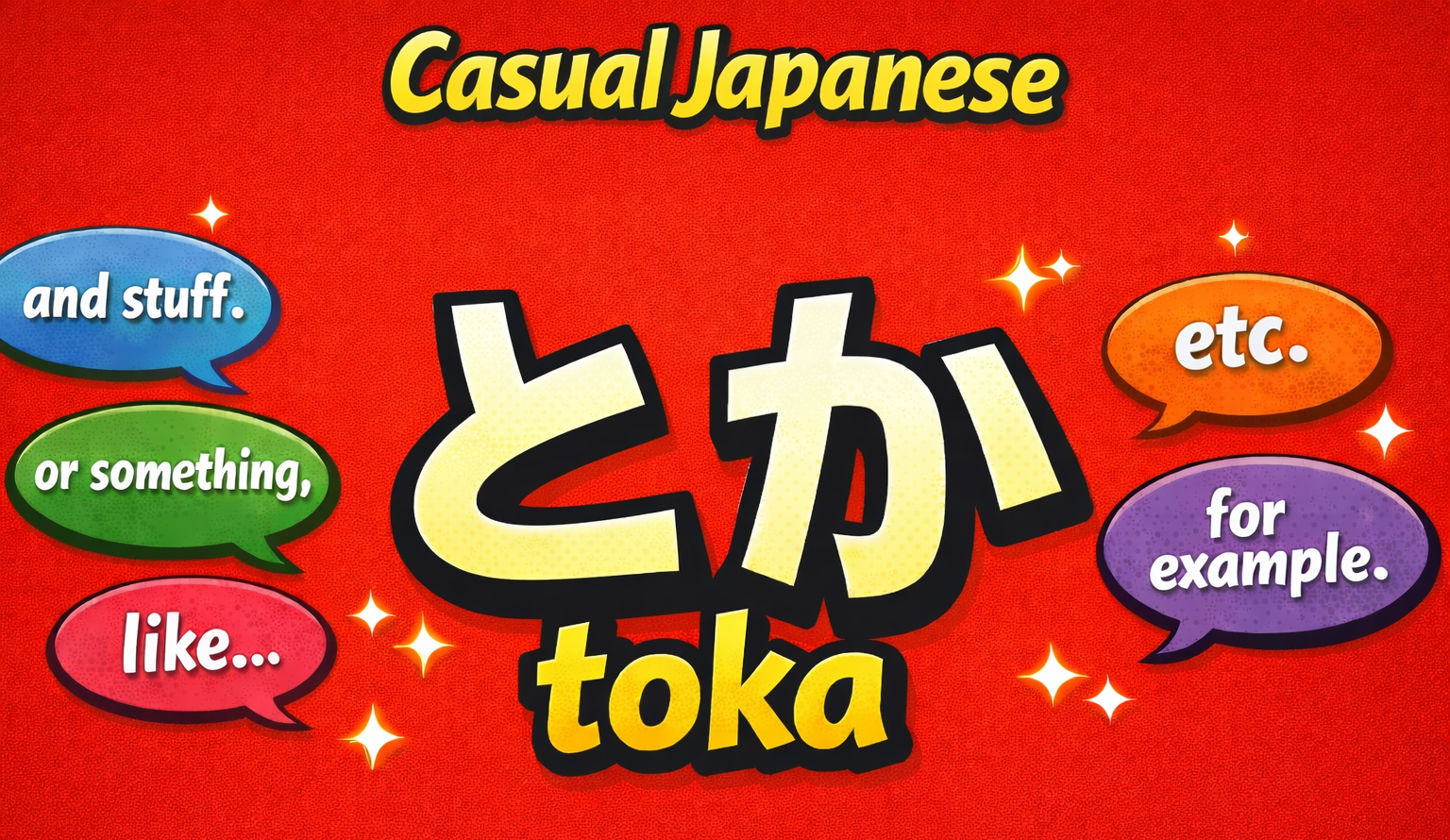
This small word is one of the most Japanese-feeling casual expressions because it’s flexible, slightly vague, and perfect for conversational flow. It often works like:
-
“and stuff”
-
“or something”
-
“like”
-
“I mean / for example”
-
“whatever / something like that”
In real speech, 「とか (toka)」 is frequently used to:
-
soften statements
-
avoid sounding too direct
-
list examples casually
-
keep things vague on purpose
- 1) What 「とか (toka)」 means (Core Grammar Explanation)
- 2) Textbook Japanese vs Real-Life Spoken Japanese
- 3) Key nuance: 「とか (toka)」 is intentionally vague
- 4) Mini Knowledge
- Difference: 「とか (toka)」 vs 「や (ya)」
- Super common combo: 「〜たりとか (…tari toka)」
- 「とか (toka)」 can act like “or something”
- A) Listing nouns casually (A とか B とか)
- B) Giving examples / “like…”
- C) “or something” / suggestion
- D) Combining with 「〜たり」 (very native!)
- E) Quoting / hearsay: 「〜とか言ってた」
- F) Softening feelings / casual emotional tone
- Quick Summary (for learners)
- Learn Japanese on Preply!
1) What 「とか (toka)」 means (Core Grammar Explanation)
Main function
「とか (toka)」 casually lists examples or adds a loose “and stuff” feeling to a phrase.
It can appear after:
-
nouns
-
verbs (plain form)
-
short clauses
Basic pattern
-
A とか B とか (A toka B toka) = …etc.
-
A とか (A toka) = …and stuff / like…
2) Textbook Japanese vs Real-Life Spoken Japanese
Textbook style (more formal / written)
Textbooks prefer:
-
「や (ya)」 (casual written listing)
-
「など (nado)」 (formal “etc.”)
-
「それから (sore kara)」 (structured sequencing)
Example:
-
本やノートを買いました。 (hon ya nooto o kai-mashita.)
= I bought books and notebooks.
Real-life spoken style
In actual conversation, Japanese people often use:
-
「とか (toka)」 for loose listing
-
「〜たりとか (…tari toka)」 combos (very common)
-
「〜とか言って (…toka itte)」 to quote casually
Example:
-
本とかノートとか買った。 (hon toka nooto toka katta.)
= I bought books and stuff.
This feels:
-
more relaxed
-
less “complete”
-
more conversational
3) Key nuance: 「とか (toka)」 is intentionally vague
When you use 「とか (toka)」, you’re often implying:
-
“I’m giving examples”
-
“There were other things too”
-
“Don’t take this as a strict list”
-
“I’m not trying to sound too serious”
This makes it ideal for:
-
storytelling
-
gossiping
-
casual complaints
-
talking about plans without committing strongly
4) Mini Knowledge
Difference: 「とか (toka)」 vs 「や (ya)」
「や (ya)」 feels slightly more “standard” and organized.
「とか (toka)」 feels more like live speech.
-
「や (ya)」: “A and B (and maybe more).”
-
「とか (toka)」: “A and B and stuff… you know.”
So if you’re going for “real native conversational Japanese,” 「とか (toka)」 wins.
Super common combo: 「〜たりとか (…tari toka)」
A very native-sounding pattern:
-
Vたり Vたり + するとか / したとか
(V tari V tari + suru toka / shita toka)
It creates a casual list of actions:
-
“did this and that…”
Example vibe:
-
「〜したりとかして (… shitari toka shite)」 = “I did stuff like…”
「とか (toka)」 can act like “or something”
Very common casual suggestion / uncertainty:
-
〜とかどう?(…toka dou?) = “How about ~ or something?”
-
〜とか言ってた (… toka itteta) = “They said something like ~”
5) Example Sentences (30 examples)
A) Listing nouns casually (A とか B とか)
1. 週末は映画とか見たよ。
しゅうまつ は えいが とか みたよ。
shuumatsu wa eiga toka mita yo.
I watched a movie and stuff on the weekend.
2. コンビニでおにぎりとか買った。
こんびに で おにぎり とか かった。
konbini de onigiri toka katta.
I bought onigiri and stuff at the convenience store.
3. 旅行は京都とか大阪に行きたい。
りょこう は きょうと とか おおさか に いきたい。
ryokou wa kyouto toka oosaka ni ikitai.
For travel, I want to go to Kyoto or Osaka or something.
4. 部屋に漫画とかフィギュアとか多すぎ。
へやに まんが とか ふぃぎゅあ とか おおすぎ。
heya ni manga toka figyua toka oosugi.
There are way too many manga and figures and stuff in my room.
5. 朝はコーヒーとか飲まないと無理。
あさ は こーひー とか のまない と むり。
asa wa koohii toka nomanai to muri.
I can’t function unless I drink coffee or something in the morning.
B) Giving examples / “like…”
6. なんかさ、昨日 とか めっちゃ疲れたんだよね。
なんかさ、きのう とか めっちゃ つかれたんだよね。
nanka sa, kinoo toka meccha tsukaretandayo ne.
Like… yesterday I got super tired.
7. あの人、ほんと天才とか言われてるよね。
あのひと、ほんと てんさい とか いわれてるよね。
ano hito, honto tensai toka iwareteru yo ne.
That person is called a genius and stuff, right?
8. スポーツとか全然できないよ。
スポーツ とか ぜんぜん できないよ。
supootsu toka zenzen dekinai yo.
I can’t do sports at all.
9. それとか、めっちゃ大事じゃない?
それとか、めっちゃ だいじじゃない?
sore toka meccha daiji janai?
Isn’t that like super important?
10. そういうのとか苦手なんだよね。
そういうの とか にがて なんだよね。
sou iu no toka nigate nan da yo ne.
I’m not good at stuff like that.
C) “or something” / suggestion
11. 今日とかひま?
きょう とか ひま?
kyou toka hima?
Are you free today or something?
12. あとで電話するとかどう?
あとで でんわする とか どう?
ato de denwa suru toka dou?
How about calling later or something?
13. 飲みに行くとかどう?
のみ に いく とか どう?
nomi ni iku toka dou?
Wanna go for drinks or something?
14. 明日とか会える?
あした とか あえる?
ashita toka aeru?
Can you meet tomorrow or something?
15. それ、店員さんに聞くとかしたら?
それ、てんいんさん に きく とか したら?
sore, ten’in-san ni kiku toka shitara?
Why don’t you ask the staff or something?
D) Combining with 「〜たり」 (very native!)
16. 週末は寝たりとかしてた。
しゅうまつ は ねたり とか してた。
shuumatsu wa netari toka shiteta.
On the weekend I just slept and stuff.
17. 家でゲームしたりとかしてた。
いえで げーむ したり とか してた。
ie de geemu shitari toka shiteta.
I was playing games at home and stuff.
18. カフェ行ったりとかして、まったりした。
かふぇ いったり とか して、まったり した。
kafe ittari toka shite, mattari shita.
I went to a café and stuff and relaxed.
19. 勉強したりとか、偉すぎ私!
べんきょう したり とか、えらすぎ わたし!
benkyou shitari toka, erasugi watashi.
I studied and stuff… I’m too responsible lol.
20. 会社の人とカラオケに行ったりとかしたんだけど、めっちゃ気まずかった〜。
かいしゃ の ひとと からおけに いったり とか したんだけど、めっちゃ きまずかった〜。
kaisha no hito to karaoke ni ittari toka shita n da kedo, meccha kimazukatta~.
I went to karaoke with people from work and stuff, but it was sooo awkward.
E) Quoting / hearsay: 「〜とか言ってた」
21. 彼、疲れたとか言ってた。
かれ、つかれた とか いってた。
kare, tsukareta toka itteta.
He said he was tired or something.
22. 明日休むとか言ってたよ。
あした やすむ とか いってたよ。
ashita yasumu toka itteta yo.
They said they’re taking tomorrow off or something.
23. あの人、英語ペラペラとか聞いた。
あのひと、えいご ぺらぺら とか きいた。
ano hito, eigo perapera toka kiita.
I heard they’re fluent in English and stuff.
24. 「もう無理」とか言い出した。
「もうむり」とか いいだした。
“mou muri” toka iidashita.
They started saying things like “I can’t do this anymore.”
25. 先生が「宿題増やす」とか言ってて最悪。
せんせい が「しゅくだい ふやす」とか いってて さいあく。
sensei ga “shukudai fuyasu” toka ittete saiaku.
The teacher was like “I’m adding more homework” and it sucked.
F) Softening feelings / casual emotional tone
26. それはさすがに無理とか思った。
それは さすがに むり とか おもった。
sore wa sasuga ni muri toka omotta.
I thought like… that’s impossible.
27. なんか、泣きそうとか思った。
なんか、なきそう とか おもった。
nanka, nakisou toka omotta.
I felt like I was going to cry.
28. もう全部やめたいとか思う日もある。
もう ぜんぶ やめたい とか おもう ひ も ある。
mou zenbu yametai toka omou hi mo aru.
Some days I feel like quitting everything.
29. それ、ちょっと怖いとかあるよね。
それ、ちょっと こわい とか あるよね。
sore, chotto kowai toka aru yo ne.
That’s kinda scary, right?
30. 今日は外出たくないとか言っていい日。
きょう は そと でたくない とか いって いい ひ。
kyou wa soto detakunai toka itte ii hi.
Today is a day where it’s okay to say “I don’t feel like going out.”
Quick Summary (for learners)
-
「とか (toka)」 = casual “and stuff / like / or something”
-
It’s real spoken Japanese and adds natural vagueness
-
Native combo: Vたりとかする (V tari toka suru)
-
Great for: chatting, gossiping, softening statements

Learn Japanese on Preply!
Preply is a very user-friendly language-learning platform, and I use it both as a tutor and as a student. I’m currently taking English, German, and Chinese lessons on Preply myself, so I can confidently recommend it from personal experience.
One of the things I like most about Preply is that it’s not a one-time booking system, but a subscription-based platform. Because you’ve already paid for lessons, it’s easier to stay motivated and think, “I’ve paid for it, so I should keep going!” (This actually helps a lot!)
At the beginning, you decide how many lessons you want to take per week. After that, you can book lessons on the days that suit your schedule, or you can set a fixed weekly lesson on the same day and time. You can also reschedule or cancel up to one day in advance, so it works well even for busy learners.
Preply also has a wide variety of teachers, including many professional tutors with qualifications and extensive experience, as well as friendly and affordable tutors for casual learners. Japanese tutors on Preply are generally very serious and dedicated, so most of them have excellent ratings (many are 5-star teachers!).
Find a tutor who matches your learning style, and enjoy studying Japanese!
If you book a trial lesson through this link, you’ll get 30% off.
Click here👇