
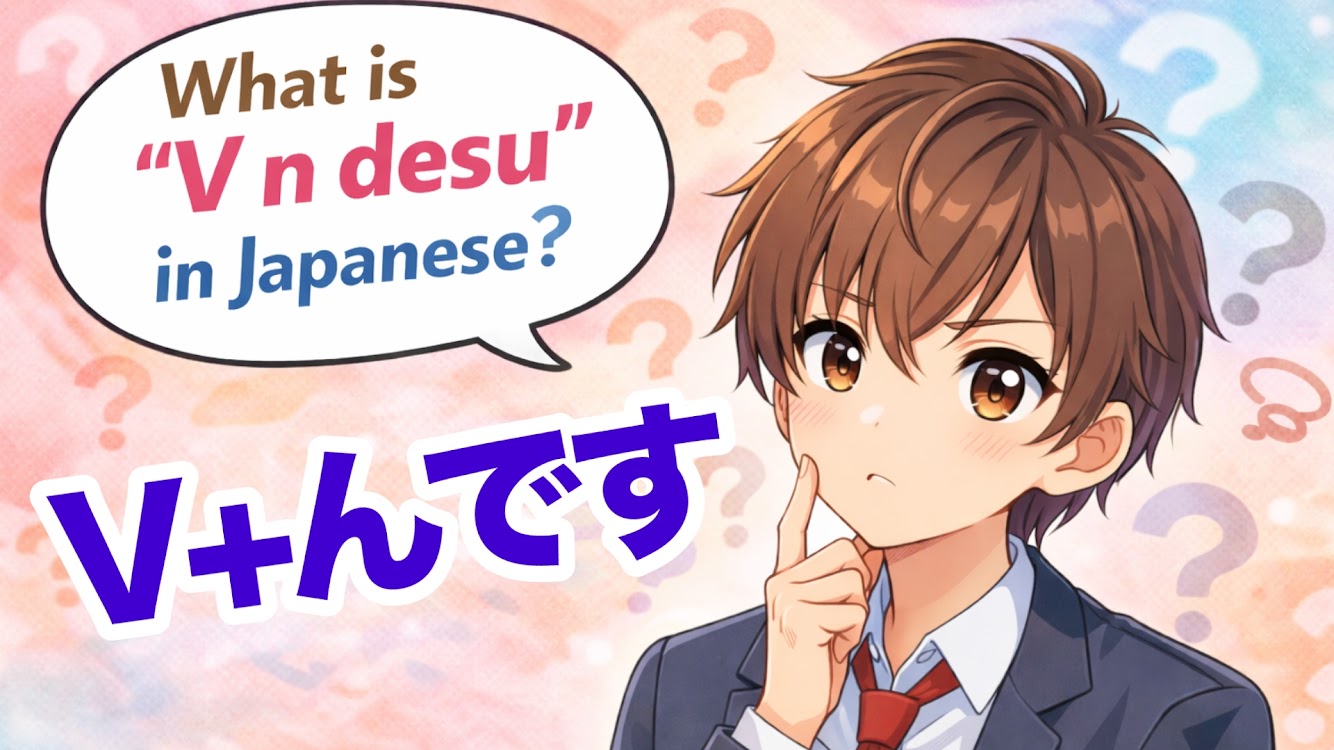
Hi! I’m Mai-sensei, a native Japanese tutor.
I offer online Japanese lessons, and you’ll find more details at the end of this article.

If you’ve studied Japanese for a while, you’ve probably heard this expression everywhere:
〜んです (n desu)
Textbooks often say things like “it’s an explanatory form” or “it sounds softer,” but that explanation usually feels… unsatisfying.
You might be thinking:
-
Why do Japanese people say 行くんです (iku n desu) instead of just 行きます (ikimasu)?
-
Is V + んです just a polite version of a verb?
-
Why does it suddenly appear when people talk about personal things like moving, quitting a job, or getting married?
Many learners use Vんです correctly by instinct, but don’t really know what it’s doing in the sentence.
And some learners avoid it altogether because it feels vague or hard to translate.
In this article, I’ll explain what “V + んです” really means, not as a memorized grammar rule, but as a tool for understanding natural Japanese conversation.
We’ll compare it with plain verbs, look at how it connects to だ / です (da / desu) and の (no), and explore why Japanese speakers use Vんです when they react to important life events.
Once you see how it works, V + んです will stop feeling mysterious—and start feeling natural.
Let’s take a closer look.
- What Does “V + んです (n desu)” Really Mean?
- Why Japanese Turns Actions into Situations
- 1. The structure of “住むんですね (sumu n desu ne)”
- 2. What changes when “の (no)” is added
- 3. Difference in listening attitude
- 4. Why important actions are nominalized
- 5. Nominalization turns action into situation
- 6. Why empathy appears naturally
- 7. Deep conversational rule in Japanese
- 8. How this connects to “だ / です (da / desu)”
- 9. Final summary
- Learn Japanese on Preply!
What Does “V + んです (n desu)” Really Mean?
Why Japanese Turns Actions into Situations
Many Japanese learners are taught that んです (n desu) is just a “softener” or a “polite explanation form.”
But if you stop there, you miss the most important point.
V + んです is not simply a verb form.
It reflects how Japanese speakers conceptualize actions as situations, not just movements.
To understand this, we need to compare plain verbs with V + んです, and also understand how だ / です (da / desu) and の (no) work together.
Let’s start with a real conversation.
A: 4月から東京の大学に行きます。
(Shigatsu kara Tōkyō no daigaku ni ikimasu.)
“I’m going to a university in Tokyo starting in April.”
B: へえ!じゃ、東京に住むんですね!
(Hee! Ja, Tōkyō ni sumu n desu ne!)
“Oh! So you’re going to live in Tokyo!”
A: はい、大学の近くに住みます。
(Hai, daigaku no chikaku ni sumimasu.)
“Yes, I’ll live near the university.”
B: アパートに住むんですか?
(Apāto ni sumu n desu ka?)
“Are you going to live in an apartment?”
A: いいえ、学生寮に住みます。
(Iie, gakusei ryō ni sumimasu.)
“No, I’ll live in a student dorm.”
At first glance, 住むんですね (sumu n desu ne) looks like a normal verb phrase.
But structurally, it is not.
1. The structure of “住むんですね (sumu n desu ne)”
“住むんですね” is built step by step:
住む (sumu) → to live
住むの (sumu no) → living (as a situation)
住むのです (sumu no desu) → it is that one lives
住むんですね (sumu n desu ne) → spoken, softened form
Here, の (no) is a nominalizer.
A nominalizer turns a whole sentence into a noun-like unit.
This means the listener is not reacting to the action “live”, but to the situation of living somewhere.
2. What changes when “の (no)” is added
Compare these two reactions:
住みますね。
(Sumimasu ne.)
“So you will live there.”
住むんですね。
(Sumu n desu ne.)
“So that’s your living situation.”
The first treats the verb as information.
The second treats it as a life event.
3. Difference in listening attitude
住みますね
Sounds like: schedule confirmation, logistics
住むんですね
Sounds like: personal decision, life change
Moving to Tokyo is not just movement.
It is a story, a choice, a change in identity.
Japanese prefers to receive that as a situation, not just an action.
4. Why important actions are nominalized
In Japanese conversation, major personal actions are rarely processed as raw verbs.
行きます
(ikimasu)
“I will go.”
行くんですね
(iku n desu ne)
“So that’s what’s happening in your life.”
結婚します
(kekkon shimasu)
“I will get married.”
結婚するんですね
(kekkon suru n desu ne)
“So you’re getting married.”
辞めます
(yamemasu)
“I will quit.”
辞めるんですね
(yameru n desu ne)
“So that’s your decision.”
The verb alone describes movement.
The nominalized form describes meaning.
5. Nominalization turns action into situation
住む (sumu)
An action
住むの (sumu no)
A situation, event, or state of life
This is why learners often feel that んです sounds emotional.
The emotion is not added manually.
It appears automatically when the speaker treats the action as part of a human story.
6. Why empathy appears naturally
By using V + んです, the listener is saying:
“I understand this not as data, but as part of your life.”
This creates warmth without emotional vocabulary.
That is why Japanese aizuchi (backchannel responses) naturally use this form.
Unnatural reactions:
行きますね
(Ikimasu ne.)
結婚しますね
(Kekkon shimasu ne.)
Natural reactions:
行くんですね
(Iku n desu ne.)
結婚するんですね
(Kekkon suru n desu ne.)
7. Deep conversational rule in Japanese
Japanese conversation does not immediately react to big life events with plain verbs.
First, it turns them into noun-like units.
Then, it responds.
This shows psychological respect for the speaker’s experience.
8. How this connects to “だ / です (da / desu)”
As explained in earlier grammar, だ / です are not verbs.
They are sentence-making grammar elements.
In V + んです, we are seeing the same system:
Verb
→ nominalizer の (no)
→ sentence marker です (desu)
This is why んです is not a casual add-on.
It is part of a core grammatical structure.
9. Final summary
In Japanese, V + んです does not merely soften speech.
It changes how an action is perceived.
Actions become situations.
Movements become meaning.
Information becomes human.
Once you understand this, Japanese conversation stops feeling vague and starts feeling intentional.
And this is why V + んです is everywhere in natural Japanese.

Learn Japanese on Preply!
Preply is a very user-friendly language-learning platform, and I use it both as a tutor and as a student. I’m currently taking English, German, and Chinese lessons on Preply myself, so I can confidently recommend it from personal experience.
One of the things I like most about Preply is that it’s not a one-time booking system, but a subscription-based platform. Because you’ve already paid for lessons, it’s easier to stay motivated and think, “I’ve paid for it, so I should keep going!” (This actually helps a lot!)
At the beginning, you decide how many lessons you want to take per week. After that, you can book lessons on the days that suit your schedule, or you can set a fixed weekly lesson on the same day and time. You can also reschedule or cancel up to one day in advance, so it works well even for busy learners.
Preply also has a wide variety of teachers, including many professional tutors with qualifications and extensive experience, as well as friendly and affordable tutors for casual learners. Japanese tutors on Preply are generally very serious and dedicated, so most of them have excellent ratings (many are 5-star teachers!).
Find a tutor who matches your learning style, and enjoy studying Japanese!
If you book a trial lesson through this link, you’ll get 30% off.
Click here👇


I am a native Japanese tutor with over 1,500 lessons taught across multiple platforms.
I majored in English at university and graduated, and I have since returned to university to study linguistics more broadly.
Related posts:
 Wakaru vs Shiru Difference: Why “Wakaru!” Feels Warm but “Shiru” Often Doesn’t
 The Japanese Verb “悩む” (Nayamu): Meaning, Usage, and Why It’s Hard to Translate
 Japanese Casual Expression: 〜っちゃ〜する (…ccha …suru)
 Why Japanese Says ‘Taxi ga iru’ (And Why ‘Aru’ Feels Wrong)
 Japanese Casual Expression: 「とか (toka)」 (A Super Common Colloquial “and stuff / like”)
 Japanese Casual Expression: 「〜っぽい (ppoi)」 (The Native Shortcut for “-ish / seems like / has the vibe of”)
 Japanese Casual Expression: 「っていうか (tte iu ka)」 (The Native Fix-It Phrase: “I mean / or rather / actually / like…”)
 Japanese Casual Expression: 〜じゃん (…jan)