
Hi! I’m Mai-sensei, a native Japanese tutor.
If you’ve been studying Japanese for a while, you’ve probably seen sentences like:
-
何も言わずに帰った。(nani mo iwazu ni kaetta.)
-
連絡せずに来た。(renraku sezu ni kita.)
-
文法を勉強せずに話せるようになりたい。(bunpou o benkyou sezu ni hanaseru you ni nari-tai.)
And if you’re a sharp learner (or a chronic overthinker… welcome to the club), you might have asked:
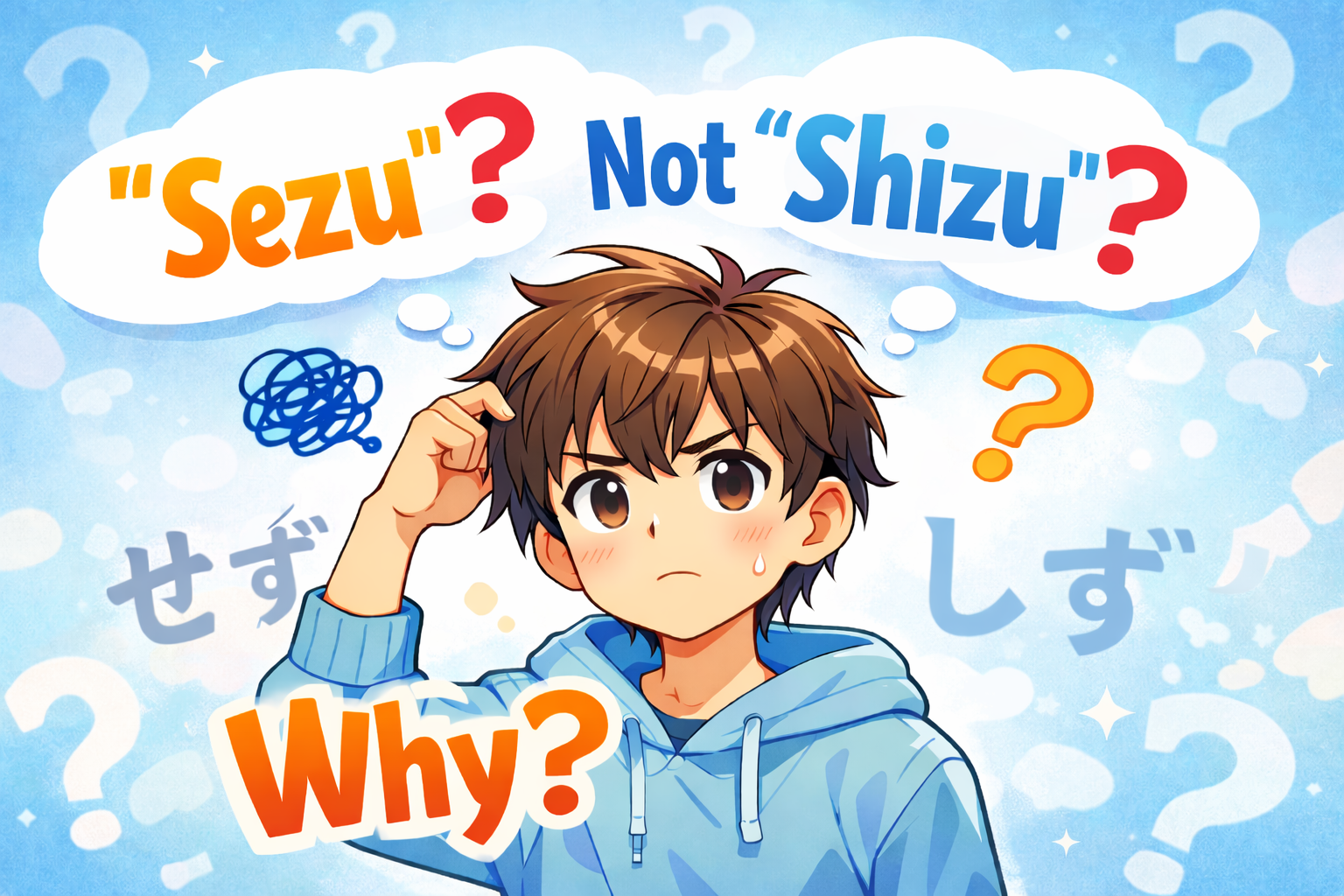
“Wait, why is it せず (sezu) and not しず (shizu)?”
Because する (suru) → しない (shinai), right?
So shouldn’t it be する (suru) → しず (shizu)?
This is actually a fantastic question.
And it reveals something super important:
~せず (sezu) is not based on modern Japanese grammar.
It comes from older / classical Japanese, and that’s why it looks “irregular.”
But don’t worry. It’s not just random chaos.
There is a reason.
Let’s unpack it.
What is ~せず (sezu), grammatically speaking?
The structure of ~せず (sezu) is:
Verb (Mizen-kei) + ず (zu)
Here’s the key term:
Mizen-kei (irrealis form / imperfective form)
“Mizen-kei” is a verb conjugation form used in classical Japanese, often appearing before negative forms.
For now, you only need one idea:
~ず (zu) attaches to the Mizen-kei form.
Examples:
-
言う (iu) → 言わず (iwazu)
-
書く (kaku) → 書かず (kakazu)
-
行く (iku) → 行かず (ikazu)
-
食べる (taberu) → 食べず (tabezu)
So far, so good.
Now comes the troublemaker…
Then why isn’t it “しず (shizu)”?
Because する (suru) does not use “し” (shi) as its Mizen-kei.
In older Japanese, する had a full conjugation set like this:
-
Mizen-kei (irrealis form): せ (se)
-
Ren’yō-kei (continuative form): し (shi)
-
Shūshi-kei (plain form): す (su)
-
Rentai-kei (attributive form): する (suru)
-
Izen-kei (realis form): すれば (sureba)
-
Meirei-kei (imperative): せよ / しろ (seyo / shiro)
So the negative ~ず form becomes:
せ (Mizen-kei) + ず → せず (sezu)
That’s it.
Not magic. Not a typo. Not a secret conspiracy.
Just… old grammar living rent-free in modern Japanese.
But why “しない” (shinai) then?
Great follow-up question.
Because ~ない (nai) is modern Japanese, and it typically attaches to a different form.
In modern Japanese:
Ren’yō-kei (continuative form) + ない (nai)
So:
-
する (suru) → し (shi) + ない (nai) → しない (shinai)
That’s why learners feel confused:
-
しない (shinai) looks like the “normal” negative
-
せず (sezu) looks like the “weird” negative
But they belong to different systems.
Quick summary:
-
しない (shinai) = modern negative (ない)
-
せず (sezu) = classical negative (ず)
Different origins, different rules.
Why does Japanese keep these older forms?
Because language is a museum and a living organism at the same time.
Even though modern Japanese doesn’t actively “use” classical conjugation systems in daily speech, many forms survive in:
-
written language
-
formal speech
-
idiomatic expressions
-
set phrases
So ~ず (zu) and ~せず (sezu) remain common, especially in writing.
Final takeaway
If you want a short answer:
- せず (sezu) is “classical-style negation,” not modern-style negation.
- ~ず (zu) attaches to the Mizen-kei form.
- The Mizen-kei of する (suru) is せ (se).
- That’s why it becomes せず (sezu).
Learn Japanese on Preply!
Preply is a very user-friendly language-learning platform, and I use it both as a tutor and as a student. I’m currently taking English, German, and Chinese lessons on Preply myself, so I can confidently recommend it from personal experience.
One of the things I like most about Preply is that it’s not a one-time booking system, but a subscription-based platform. Because you’ve already paid for lessons, it’s easier to stay motivated and think, “I’ve paid for it, so I should keep going!” (This actually helps a lot!)
At the beginning, you decide how many lessons you want to take per week. After that, you can book lessons on the days that suit your schedule, or you can set a fixed weekly lesson on the same day and time. You can also reschedule or cancel up to one day in advance, so it works well even for busy learners.
Preply also has a wide variety of teachers, including many professional tutors with qualifications and extensive experience, as well as friendly and affordable tutors for casual learners. Japanese tutors on Preply are generally very serious and dedicated, so most of them have excellent ratings (many are 5-star teachers!).
Find a tutor who matches your learning style, and enjoy studying Japanese!
If you book a trial lesson through this link, you’ll get 30% off.
Click here👇