
Hi! I’m Mai-sensei, a native Japanese tutor.
I’m currently accepting online Japanese lessons. Details are written at the end of this article.
- What does Nayamu mean?
- The Surprisingly Wide Range of 悩む (nayamu)
- What Is Being “Worried About”? The Object Problem
- 悩む (nayamu) Is About a Mental State, Not an Action on Someone
- When 悩む (nayamu) Suddenly Looks Transitive
- Positive 悩み (nayami) Also Exists
- Contrast: 悩まされる (nayamasareru) Is Always Negative
- Why English Translations Always Feel “Off”
- Conclusion
- Learn Japanese on Preply!
What does Nayamu mean?
If you have studied Japanese for a while, you have probably encountered the verb 悩む (nayamu) and felt that something about it is… vague.
It often gets translated as “to worry” or “to be troubled,” but those English words don’t fully capture how Japanese people actually use 悩む (nayamu) in daily life.
In this article, I’ll explain:
- Why 悩む (nayamu) covers an unusually wide emotional range
- How it can describe both heavy suffering and light hesitation
- Why its grammar confuses learners, especially around objects
- How Japanese speakers use it for both negative and even positive situations
By the end, you’ll see why 悩む (nayamu) is not just a vocabulary word, but a window into Japanese thinking.
The Surprisingly Wide Range of 悩む (nayamu)
One reason 悩む (nayamu) is hard to translate is that it can describe very different levels of emotional weight.
Heavy, serious suffering
- 人生に悩んで絶望している
Jinsei ni nayande zetsubō shite iru
“I am suffering over my life and feel hopeless.”
Here, 悩む (nayamu) is close to anguish or deep emotional distress.
Medium-level, long consideration
- 散々悩んだ挙句、何も買わなかった
Sanzan nayanda ageku, nani mo kawanakatta
“After thinking about it for a long time, I ended up buying nothing.”
This is not despair. It’s prolonged consideration and mental effort.
Light, casual hesitation
- 焼肉と寿司、どっちも食べたいから悩むな〜
Yakiniku to sushi, docchi mo tabetai kara nayamu nā
“I want both yakiniku and sushi, so I can’t decide.”
In English, we’d never say “I’m suffering” here.
But Japanese still naturally uses 悩む (nayamu).
This huge emotional range already makes translation difficult.
What Is Being “Worried About”? The Object Problem
Learners often ask:
Is 悩む (nayamu) transitive or intransitive?
Textbooks usually say it’s intransitive, meaning it doesn’t take a direct object.
But real Japanese is not that simple.
A common learner confusion
- 部下を悩んでいます ❌
Buka o nayande imasu
(Ungrammatical) - 部下のことを悩んでいます △
Buka no koto o nayande imasu
(Grammatically possible, but sounds awkward) - 部下のことで悩んでいます ◎
Buka no koto de nayande imasu
“I’m worried about my subordinate.”
Native speakers strongly prefer 〜で悩む (de nayamu) rather than directly marking the person as an object.
Why?
Because the person is not the problem.
The situation, responsibility, or decision related to that person is.
悩む (nayamu) Is About a Mental State, Not an Action on Someone
Japanese tends to avoid framing emotions as something you “do” to another person.
- 部下のことで悩んでいます
Buka no koto de nayande imasu
“I am troubled by an issue involving my subordinate.”
This keeps the focus on the speaker’s internal state, not on blaming the subordinate.
When 悩む (nayamu) Suddenly Looks Transitive
At the same time, native speakers say things like:
- 今まさにそれを悩んでるんだよね
Ima masani sore o nayanderu n da yo ne
“I’m literally in the middle of thinking that through right now.”
So what happened to “intransitive”?
Here, それ (sore) is not a person.
It is a clearly defined issue or decision, mentally packaged as a single object.
Japanese allows this shift because:
- The speaker conceptualizes the problem as one “unit”
- Conversation allows heavy omission and compression
This is why you’ll often see explanations like:
“It’s an intransitive verb, but it can have transitive-like usage.”
It’s not sloppy grammar.
It’s cognition-driven grammar.
Positive 悩み (nayami) Also Exists
Another reason 悩む (nayamu) is tricky:
The content of a 悩み (nayami) is not always negative.
- 部下に能力があるが、今の部署では活かせない
Buka ni nōryoku ga aru ga, ima no busho de wa ikasenai
“My subordinate has great ability, but can’t use it in the current department.” - 彼のために配置換えを相談すべきか悩んでいる
Kare no tame ni haichi-gae o sōdan subeki ka nayande iru
“I’m deliberating over whether I should discuss a transfer for his sake.”
This is a forward-looking, considerate kind of concern / deliberation, not suffering.
English “worry” often sounds negative.
Japanese 悩む (nayamu) does not necessarily.
Contrast: 悩まされる (nayamasareru) Is Always Negative
Now compare:
- 私は部下に悩まされている
Watashi wa buka ni nayamasarete iru
“My subordinate is causing me stress.”
This passive form clearly means:
- The speaker is being emotionally burdened
- The situation is unwanted
- The feeling is negative
Notice how the grammar changes the emotional framing completely.
Why English Translations Always Feel “Off”
English forces you to choose:
- worry
- struggle
- suffer
- be troubled
- be unsure
- hesitate
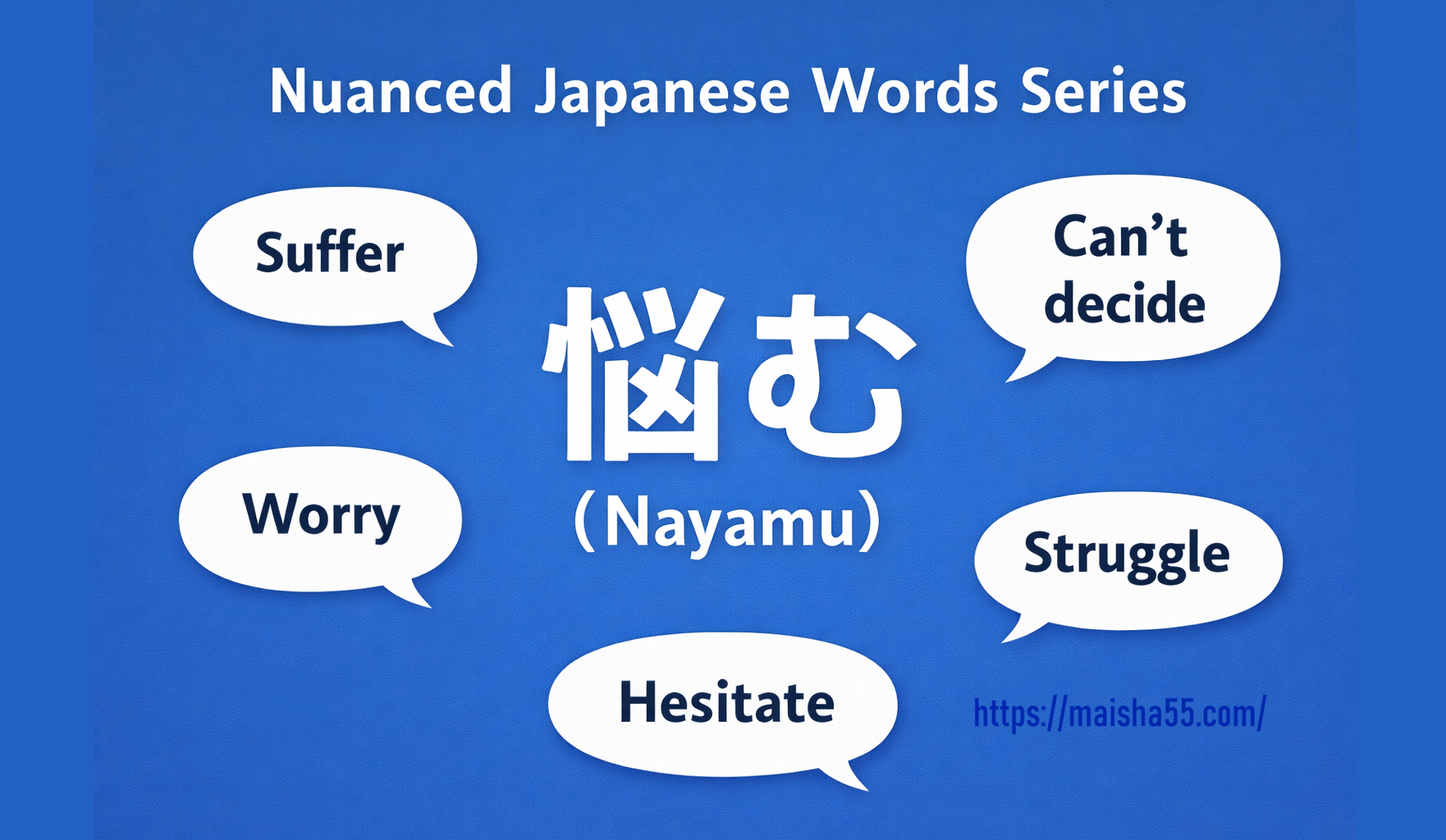
Japanese 悩む (nayamu) comfortably covers all of these depending on context.
That’s why learners feel:
“I understand the sentence, but the translation feels wrong.”
That feeling is correct.
Conclusion
悩む (nayamu) is hard to translate because:
- It spans from deep anguish to light indecision
- It focuses on internal mental states rather than external actions
- Its grammar shifts with the speaker’s perspective
- It can describe both negative and positive concerns
- Japanese prioritizes cognition and context over rigid transitivity
Understanding 悩む (nayamu) isn’t just about vocabulary.
It’s about understanding how Japanese speakers frame emotions, responsibility, and decision-making.
And yes, from a learner’s point of view…
Japanese really is complicated. But beautifully so.

Learn Japanese on Preply!
Preply is a very user-friendly language-learning platform, and I use it both as a tutor and as a student. I’m currently taking English, German, and Chinese lessons on Preply myself, so I can confidently recommend it from personal experience.
One of the things I like most about Preply is that it’s not a one-time booking system, but a subscription-based platform. Because you’ve already paid for lessons, it’s easier to stay motivated and think, “I’ve paid for it, so I should keep going!” (This actually helps a lot!)
At the beginning, you decide how many lessons you want to take per week. After that, you can book lessons on the days that suit your schedule, or you can set a fixed weekly lesson on the same day and time. You can also reschedule or cancel up to one day in advance, so it works well even for busy learners.
Preply also has a wide variety of teachers, including many professional tutors with qualifications and extensive experience, as well as friendly and affordable tutors for casual learners. Japanese tutors on Preply are generally very serious and dedicated, so most of them have excellent ratings (many are 5-star teachers!).
Find a tutor who matches your learning style, and enjoy studying Japanese!
If you book a trial lesson through this link, you’ll get 30% off.
Click here👇


I am a native Japanese tutor with over 1,500 lessons taught across multiple platforms.
I majored in English at university and graduated, and I have since returned to university to study linguistics more broadly.
Related posts:
 Wakaru vs Shiru Difference: Why “Wakaru!” Feels Warm but “Shiru” Often Doesn’t
 Why Japanese Says ‘Taxi ga iru’ (And Why ‘Aru’ Feels Wrong)
 Japanese Casual Expression: 〜っちゃ〜する (…ccha …suru)
 V-masu or V-n desu? When and Why Japanese Uses “んです” (n desu)
 Japanese Casual Expression: 「とか (toka)」 (A Super Common Colloquial “and stuff / like”)
 Japanese Casual Expression: 「〜っぽい (ppoi)」 (The Native Shortcut for “-ish / seems like / has the vibe of”)
 Japanese Casual Expression: 「っていうか (tte iu ka)」 (The Native Fix-It Phrase: “I mean / or rather / actually / like…”)
 Japanese Casual Expression: 〜じゃん (…jan)