
Hi! I’m Mai-sensei, a native Japanese tutor.
If you’ve ever heard a Japanese person say something like
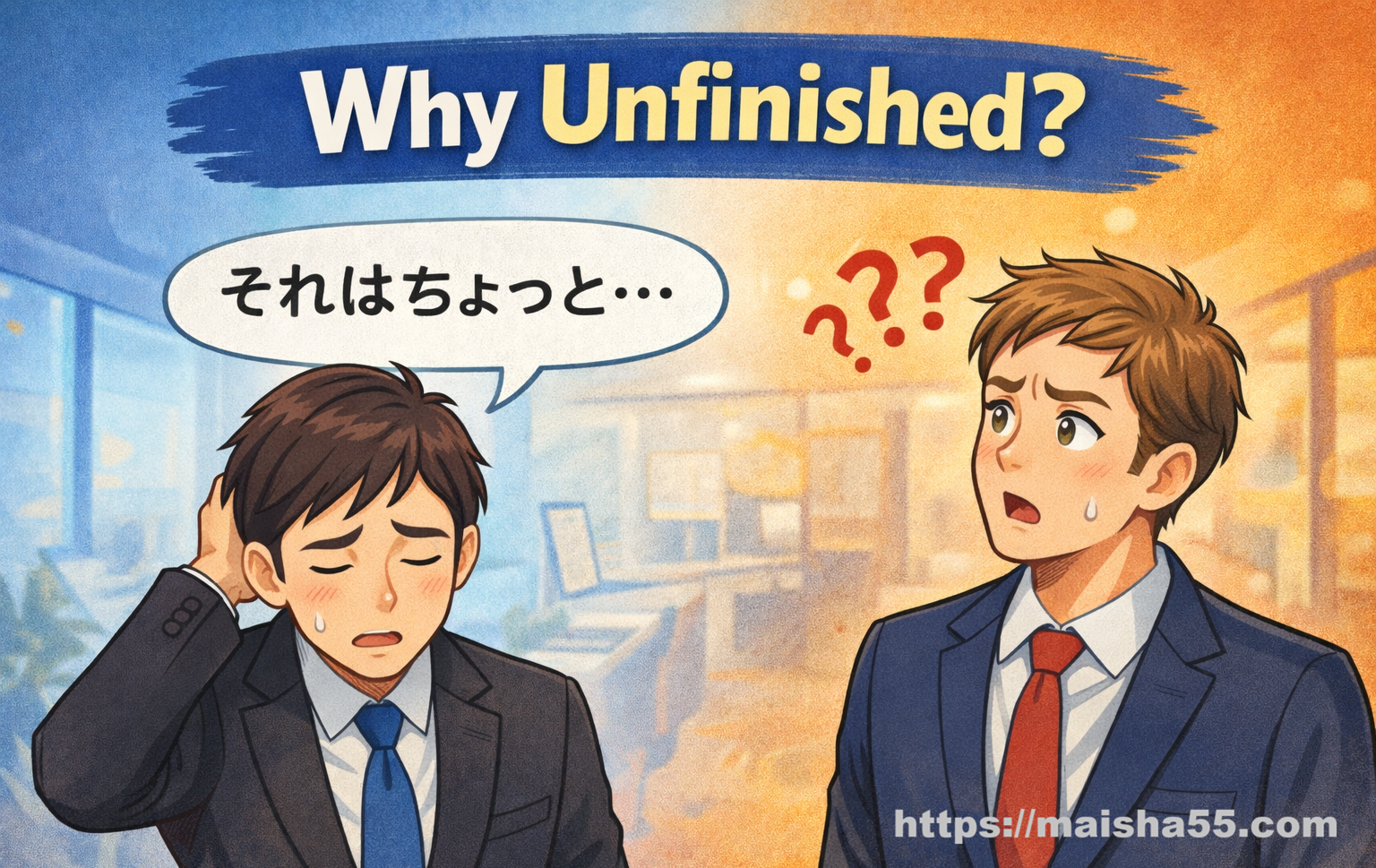
「それはちょっと…」
Sore wa chotto…
“That’s a bit…”
and then just… stop talking,
you’ve experienced one of the most important (and confusing) features of Japanese communication:
Not finishing the sentence on purpose.
To English speakers, this can feel incomplete or vague.
To many Japanese speakers, it’s perfectly clear.
Often it means:
- “No.”
- “I don’t really like that.”
- “That’s not a good idea.”
- “I strongly disagree, but I don’t want to say it directly.”
In this post, we’ll look at:
- Why finishing the sentence can sound harsh in Japanese
- How Japanese people use “unfinished” sentences to soften refusal or criticism
- 30 real examples with English translations
- Direct “finished” versions that can sound too strong
- Why “Saying It All” Can Sound Too Strong
- The Pattern: Start a Negative, Then Trail Off
- Examples of “Unfinished” Japanese (With Hidden Negative Meaning)
- “Chotto…” Is a Magical Softening Word
- “Unfinished” vs “Finished”: Tone Shift in Japanese
- How This Connects Back to AI & “Harsh Japanese”
- When You Do Need to Be Direct
- Conclusion: Saying Less, Communicating More
- Learn Japanese on Preply!
Why “Saying It All” Can Sound Too Strong
Compared to English, Japanese often prefers to:
- Avoid direct confrontation
- Protect the other person’s face
- Leave some things unsaid but strongly implied
So if you say:
「それはダメです。」
Sore wa dame desu.
“That’s no good.”
it can sound very blunt, especially in a casual or semi-formal context.
Instead, many Japanese speakers will stop before the “judgment word”:
「それはちょっと…」
Sore wa chotto…
“That’s a bit…” (→ actually means “That’s not good / I don’t like it.”)
The rest of the sentence is silently filled in by the listener.
This is where 空気を読む (“reading the air”) becomes important.
If the listener expects a complete sentence and keeps waiting, you get:
Long, awkward silence. 😊💦
But from the Japanese side, the message was already delivered:
“I’m politely refusing / disagreeing.”
The Pattern: Start a Negative, Then Trail Off
A very common pattern looks like this:
[Topic] + は / が / ちょっと…
(Topic + wa / ga/ chotto …)
or
[Opinion intro] + と思うんですけど… / かもしれないんですが…
(Opinion intro + to omoundesu kedo… / kamo shirenaindesu ga…)
The sentence begins to move in a negative direction, then fades out.
Let’s look at concrete examples.
Examples of “Unfinished” Japanese (With Hidden Negative Meaning)
For each example:
- Soft / unfinished version (natural Japanese)
- Romaji
- Likely hidden meaning in English
- More direct “finished” version (often too strong)
You don’t have to memorize all of them, but you’ll start to feel the pattern.
それはちょっと…
- JP: それはちょっと…
- Romaji: Sore wa chotto…
- Hidden meaning: “I don’t really like that / I don’t agree / That’s not a good idea.”
- Direct version:
- それはよくないと思います。
Sore wa yokunai to omoimasu. – “I think that’s not good.”
- それはよくないと思います。
明日はちょっと予定が…
- JP: 明日はちょっと予定が…
- Romaji: Ashita wa chotto yotei ga…
- Hidden meaning: “I’m busy tomorrow, so I can’t go.”
- Direct version:
- 明日は行けません。
Ashita wa ikemasen. – “I can’t go tomorrow.”
- 明日は行けません。
多分いいんじゃないかと…
- JP: 多分いいんじゃないかと…
- Romaji: Tabun iin ja nai ka to…
- Hidden meaning: “Maybe it’s okay… but I’m not very confident / I’m not sure.”
- Direct version:
- それで大丈夫だと思います。
Sore de daijōbu da to omoimasu. – “That should be fine.”(⚠️ ”Sore de daijōbu da to omoimasu”: This phrasing isn’t rude and is generally fine to use, but it can sound very certain, so be careful not to give the wrong impression.)
- それで大丈夫だと思います。
でも、それってちょっと…
- JP: でも、それってちょっと…
- Romaji: Demo, sore tte chotto…
- Hidden meaning: “But that’s kind of a problem / I don’t really like that.”
- Direct version:
- でも、それは問題があります。
Demo, sore wa mondai ga arimasu. – “But that’s a problem.”
- でも、それは問題があります。
うーん、どうかな…
- JP: うーん、どうかな…
- Romaji: Uun, dō kana…
- Hidden meaning: “I’m not convinced / I don’t think that’s a good idea.”
- Direct version:
- あまりいい考えだとは思いません。/ あまりいい考えじゃないと思います。
Amari ii kangae da to wa omoi-masen./amari ii kangae ja nai to omoi-masu. – “I don’t really think it’s a good idea.”
- あまりいい考えだとは思いません。/ あまりいい考えじゃないと思います。
今回はちょっと…
- JP: 今回はちょっと…
- Romaji: Konkai wa chotto…
- Hidden meaning: “I’ll pass this time.”
- Direct version:
- 今回は参加しません。
Konkai wa sanka shimasen. – “I won’t join this time.”
- 今回は参加しません。
私にはちょっと…
- JP: 私にはちょっと…
- Romaji: Watashi ni wa chotto…
- Hidden meaning: “That’s not really for me / I’m not comfortable with that.”
- Direct version:
- 私には合いません。
Watashi ni wa aimasen. – “It doesn’t suit me.”
- 私には合いません。
時間的に、ちょっと…
- JP: 時間的に、ちょっと…
- Romaji: Jikan-teki ni, chotto…
- Hidden meaning: “I don’t really have time / It’s difficult schedule-wise.”
- Direct version:
- 時間がないので無理です。
Jikan ga nai node muri desu. – “I don’t have time, so it’s impossible.”
- 時間がないので無理です。
予算的に、ちょっと…
- JP: 予算的に、ちょっと…
- Romaji: Yosan-teki ni, chotto…
- Hidden meaning: “It’s too expensive / It’s over budget.”
- Direct version:
- 予算オーバーなので無理です。
Yosan ōbā na node muri desu. – “It’s over budget, so we can’t.”
- 予算オーバーなので無理です。
会社的に、ちょっと…
- JP: 会社的に、ちょっと…
- Romaji: Kaisha-teki ni, chotto…
- Hidden meaning: “The company won’t allow this / It’s not acceptable here.”
- Direct version:
- 会社のルール的に認められません。
Kaisha no rūru-teki ni mitomeraremasen. – “It’s not allowed by company rules.”
- 会社のルール的に認められません。
その表現は、あまり…
- JP: その表現は、あまり…
- Romaji: Sono hyōgen wa, amari…
- Hidden meaning: “That expression isn’t very good / sounds off.”
- Direct version:
- その表現は不自然です。
Sono hyōgen wa fushizen desu. – “That expression is unnatural.”
- その表現は不自然です。
それはあんまり…
- JP: それはあんまり…
- Romaji: Sore wa anmari…
- Hidden meaning: “I don’t really like that / That’s not great.”
- Direct version:
- それは好きではありません。
Sore wa suki de wa arimasen. – “I don’t like that.”
- それは好きではありません。
うーん、あまりおすすめは…
- JP: うーん、あまりおすすめは…
- Romaji: Uun, amari osusume wa…
- Hidden meaning: “I wouldn’t really recommend it.”
- Direct version:
- それはおすすめできません。
Sore wa osusume dekimasen. – “I can’t recommend that.”
- それはおすすめできません。
もう少し様子を見てから…
- JP: もう少し様子を見てから…
- Romaji: Mō sukoshi yōsu o mite kara…
- Hidden meaning: “Let’s wait / I don’t want to do it yet.”
- Direct version:
- 今はやめておきましょう。
Ima wa yamete okimashō. – “Let’s not do it now.”
- 今はやめておきましょう。
まあ、悪くはないんですけど…
- JP: まあ、悪くはないんですけど…
- Romaji: Mā, waruku wa nain desu kedo…
- Hidden meaning: “It’s not terrible, but I don’t really like it / there are problems.”
- Direct version:
- あまり良くないと思います。
Amari yokunai to omoimasu. – “I don’t think it’s very good.”
- あまり良くないと思います。
まあ、そういうのもアリですけど…
- JP: まあ、そういうのもアリですけど…
- Romaji: Mā, sō iu no mo ari desu kedo…
- Hidden meaning: “It’s technically acceptable, but I don’t really support it.”
- Direct version:
- あまり良い案だとは思いません。
Amari yoi an da to wa omoimasen. – “I don’t think it’s a very good idea.”
- あまり良い案だとは思いません。
いまはちょっとタイミングが…
- JP: いまはちょっとタイミングが…
- Romaji: Ima wa chotto taimingu ga…
- Hidden meaning: “Now is not a good time / I don’t want to do it now.”
- Direct version:
- いまはタイミングが悪いのでやめておきたいです。
Ima wa taimingu ga warui node yamete okitai desu. – “The timing is bad, so I’d rather not.”
- いまはタイミングが悪いのでやめておきたいです。
また今度…
- JP: また今度…
- Romaji: Mata kondo…
- Hidden meaning: “Not now (and maybe never).”
- Direct version:
- 今日は無理です。
Kyō wa muri desu. – “I can’t today.”
- 今日は無理です。
機会があれば…
- JP: 機会があれば…
- Romaji: Kikai ga areba…
- Hidden meaning: “Probably not, unless something special happens.”
- Direct version:
- 特に予定はしていません。
Toku ni yotei wa shiteimasen. – “I’m not really planning to.”
- 特に予定はしていません。
そうですねぇ…なんとも…
- JP: そうですねぇ…なんとも…
- Romaji: Sō desu nē… nantomo…
- Hidden meaning: “I don’t want to say it’s good / I’d rather not answer.”
- Direct version:
- 評価しにくいですが、あまり良くないと思います。
Hyōka shinikui desu ga, amari yokunai to omoimasu. – “It’s hard to evaluate, but I don’t think it’s very good.”
- 評価しにくいですが、あまり良くないと思います。
うーん…なんか、違う気が…
- JP: うーん…なんか、違う気が…
- Romaji: Uun… nanka, chigau ki ga…
- Hidden meaning: “It doesn’t feel right / I think it’s wrong.”
- Direct version:
- それは違うと思います。
Sore wa chigau to omoimasu. – “I think that’s wrong.”
- それは違うと思います。
“Chotto…” Is a Magical Softening Word
One of the most “magical” softeners in Japanese is:
「ちょっと…」
Chotto…
On the surface it just means “a little,” but in real communication it often carries a much stronger nuance:
『Chotto…』 is a magical word, above all.
Some examples:
-
それはちょっと…。
Sore wa chotto…
→ “That’s a bit…” (actually: “I don’t really like that / I don’t agree.”) -
明日はちょっと予定が…。
Ashita wa chotto yotei ga…
→ “Tomorrow I kind of have plans…” (actually: “I can’t tomorrow.”) -
その案はちょっとリスクが…。
Sono an wa chotto risuku ga…
→ “That plan has a bit of risk…” (actually: “It’s too risky.”)
By adding ちょっと and then not finishing the sentence, the speaker:
-
Signals a negative or hesitant feeling
-
Softens the impact
-
Gives the other person a chance to gracefully back off
If you replace these with fully finished, direct sentences like:
-
それはよくありません。
Sore wa yoku arimasen. – “That’s not good.” -
明日は行けません。
Ashita wa ikemasen. – “I can’t go tomorrow.” -
その案はリスクが高すぎます。
Sono an wa risuku ga takasugimasu. – “That plan is too risky.”
you might be grammatically perfect, but you can easily sound much harsher than you intended.
So when you listen to Japanese people speak, watch for:
-
Sentences that start negative and fade out
-
Frequent use of 「ちょっと…」
-
Soft endings like 「…かなと」(kana to) ,「…かもしれませんが」(kamo shire-masen ga)
They are not “unfinished mistakes.”
They are politeness in action.
“Unfinished” vs “Finished”: Tone Shift in Japanese
If you compare all the pairs above, you’ll notice a pattern:
- The unfinished versions leave space and soften the impact
- The finished versions sound clear but also more critical / final / harsh
In English, we’re often taught to:
- “Say what you mean.”
- “Be clear and direct.”
- “Finish your sentences.”
In Japanese, especially in delicate situations, it’s often more appropriate to:
- Start the sentence
- Show your direction (negative / hesitant / disagreeing)
- Then leave it floating
The rest is carried by:
- Shared context
- Tone of voice
- Facial expression
- Silence
If you keep waiting for a “full sentence,” you may accidentally push the other person into an uncomfortable corner, creating the famous awkward silence.
How This Connects Back to AI & “Harsh Japanese”
When AI translates directly from English-style communication into Japanese, it often:
- Finishes the sentence completely
- Labels things clearly (“失敗です”, “間違っています”)
- Skips the soft, unfinished patterns that Japanese people use
The result can be:
Grammatically perfect,
but emotionally… a punch in the face.
For smoother communication with Japanese people, it’s not enough to know grammar.
You also need to understand:
How to not say something, and still say it.
If you’re writing prompts for AI, you can literally ask it:
“Please use soft, natural Japanese that sometimes leaves sentences unfinished, like
「それはちょっと…」 or 「明日はちょっと予定が…」 when refusing or being negative.”
That way, your AI helper becomes a little more Japanese too. 😊
When You Do Need to Be Direct
Of course, there are situations where “unfinished” Japanese is not appropriate.
In contexts like:
-
Legal contracts
-
Company policies
-
Safety instructions
-
Clear warnings
Japanese also needs explicit, direct language.
But in normal daily conversation (with friends, colleagues, family, even many business situations), a very direct, fully finished negative sentence can feel:
-
Too strong
-
Too cold
-
Too final
So the skill is:
Knowing when to be legally / formally clear, and when to be socially gentle.
Conclusion: Saying Less, Communicating More
In Japanese, how you stop talking can be just as meaningful as what you say.
- “Unfinished” sentences like
「それはちょっと…」 (Sore wa chotto…) or
「明日はちょっと予定が…」 (Ashita wa chotto yotei ga…)
often carry a soft no, a gentle warning, or quiet disagreement. - “Finished” sentences like
「それはよくありません。」 (Sore wa yoku arimasen.) or
「明日は行けません。」 (Ashita wa ikemasen.)
are clearer and not necessarily rude, but can sound much stronger and more final.
In contracts, rules, safety messages, or legal contexts, this kind of direct, finished Japanese is necessary.
In everyday conversation, however, Japanese speakers often:
- Use ちょっと as a magical softener
- Leave sentences unfinished
- Rely on context and silence to deliver the message
For learners (and for AI), understanding this difference is crucial:
Grammatically correct Japanese is only the start.
Truly natural Japanese means knowing when to finish the sentence…
and when to let it gently fade out.

Learn Japanese on Preply!
Preply is a very user-friendly language-learning platform, and I use it both as a tutor and as a student. I’m currently taking English, German, and Chinese lessons on Preply myself, so I can confidently recommend it from personal experience.
One of the things I like most about Preply is that it’s not a one-time booking system, but a subscription-based platform. Because you’ve already paid for lessons, it’s easier to stay motivated and think, “I’ve paid for it, so I should keep going!” (This actually helps a lot!)
At the beginning, you decide how many lessons you want to take per week. After that, you can book lessons on the days that suit your schedule, or you can set a fixed weekly lesson on the same day and time. You can also reschedule or cancel up to one day in advance, so it works well even for busy learners.
Preply also has a wide variety of teachers, including many professional tutors with qualifications and extensive experience, as well as friendly and affordable tutors for casual learners. Japanese tutors on Preply are generally very serious and dedicated, so most of them have excellent ratings (many are 5-star teachers!).
Find a tutor who matches your learning style, and enjoy studying Japanese!
If you book a trial lesson through this link, you’ll get 30% off.
Click here👇