Hi! I’m Mai-sensei, a native Japanese tutor.
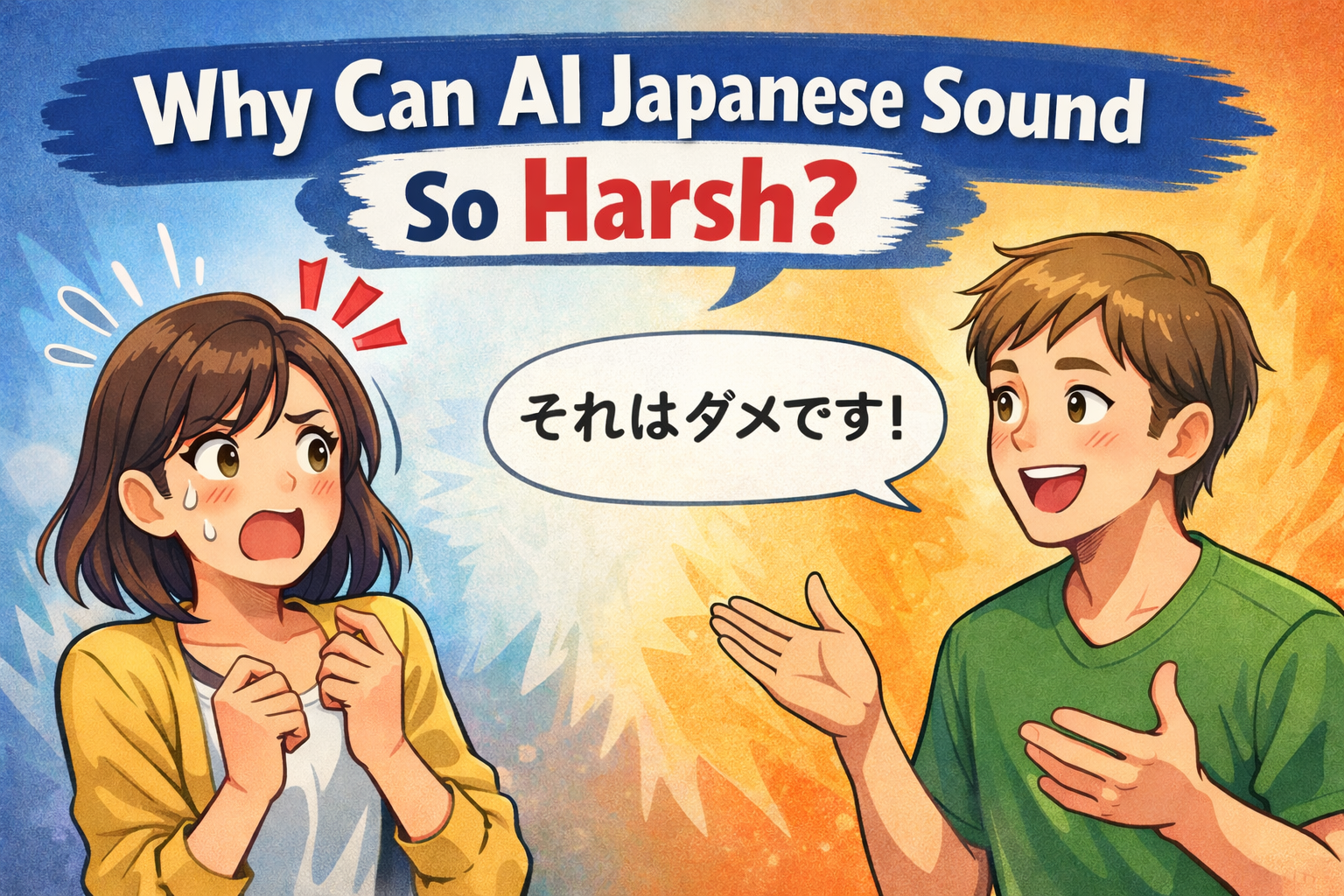
Recently, I had a very “educational” (read: mildly traumatizing) conversation with an AI in Japanese.
The grammar was perfect.
The vocabulary was fine.
And yet… the tone felt like being hit with a brick of “correctness.”
I was talking about my worries and plans, and the AI replied with things like:
「これがあなたの癖です。」(kore ga anata no kuse desu.)
“This is your habit.”
「あなたはすぐ極端に振れすぎます。」(anata wa sugu kyokutan ni fure sugi masu.)
“You swing to extremes too easily.”
Later, when I shared something I wanted to try, it responded with:
「もしそうなったら、失敗。」(moshi soo nattara, shippai.)
“If that happens: failure.”
Grammatically correct? Yes.
Emotionally and culturally appropriate Japanese? Not really.
As a Japanese teacher, this hit a nerve.
So this post is a little PSA for learners:
When you use AI to learn Japanese, please don’t assume that “grammatically correct = socially okay.”
Why AI Japanese Can Sound So Harsh
Most large language models are trained on multiple languages at once, and a lot of the “communication style” comes from English.
In English, we often see:
- Direct feedback like:
“That’s your pattern.”
“You’re being too extreme.” - “Tough love” or therapy-style language that is honest and straightforward.
- Very clear labels: success / failure, right / wrong.
When this style gets translated directly into Japanese, you can end up with:
- 「これがあなたの癖です。」(kore ga anata no kuse desu.)
- 「あなたはすぐ極端に振れます。」(anata wa sugu kyokutan ni fure masu.)
- 「もしそうなったら、失敗。」(moshi soo nattara, shippai.)
The grammar is fine.
But in Japanese, these sentences can sound:
- Judgy
- Cold
- Weirdly “diagnostic,” like a counselor who has known you for five minutes and is already writing your case report
For many Japanese people, this is way too strong unless:
- You’re very close friends and joking
- You have a formal therapeutic relationship
- Or you are in a very blunt, high-conflict context (which most learners are not)
Problem Example 1: “This Is Your Habit”
「これがあなたの癖です。」(kore ga anata no kuse desu.)
Literal meaning:
“This is your habit / pattern.”
What it sounds like in Japanese:
- You’re defining the person’s personality from a superior position
- You’re “diagnosing” them
- You’re placing a label on them without much sensitivity
For most relationships (teacher–student, casual friends, online chat partners), this can feel very rude or condescending.
Softer, more natural alternatives
Here are some ways a Japanese native speaker might express a similar idea more gently:
- 「こういう考え方をしやすいところがあるかもしれません。」(koo iu kangae-kata o shi-yasui tokoro ga aru kamo shire-masen.)
You might have a tendency to think this way.
- 「少し、こういう方向に考えが行きやすいのかな、という印象があります。」(sukoshi, koo iu hookoo ni kangae ga iki-yasui no kana, to iu inshoo ga ari-masu.)
I get the impression that your thoughts may tend to go in this direction a bit.
- 「もしかしたら、ここがパターンになっているのかもしれないですね。」(moshikashitara, koko ga pataan ni natte-iru no kamo shirenai desu ne.)
It might be that this has become something of a pattern.
Notice the tools:
- かもしれません (kamo shire-masen)
- 〜かなという印象です (kana to iu inshoo desu)
- 〜気がします (ki ga shi-masu)
All of these create distance and soften judgment.
In Japanese, this kind of softening is not cowardice. It’s politeness and care.
Problem Example 2: “If That Happens: Failure.”
This one really made me laugh (after I got over the irritation):
「もしそうなったら、失敗。」(moshi soo nattara, shippai.)
“If that happens: failure.”
From a Japanese native perspective, this kind of sentence-final noun:
- 「失敗。」(shippai)
- 「終わり。」(owari)
- 「アウト。」(auto)
used as a cold label is extremely strong.
Of course, friends might say jokingly:
- 「それはもう完全にアウトw」(sore wa moo kanzen ni auto)
- 「それやったら即死だよw」(sore yattara sokushi dayo)
But in a serious discussion, especially with someone you don’t know well, simply stamping:
「失敗。」(shippai.)
on someone’s plan sounds:
- Dismissive
- Absolute
- Lacking nuance
Softer alternatives a Japanese native might choose
Instead of:
「もしそうなったら、失敗。」(moshi soo nattara, shippai.)
We might say:
- 「もしそうなってしまったら、あまりうまくいかないかもしれませんね。」(moshi soo natte shimattara, amari umaku ikanai kamo shire-masen ne.)
If it ends up like that, it might not go very well.
- 「そうなると、かなりリスクが大きいかなという気がします。」(soo naru to, kanari risuku ga ookii kana to iu ki ga shi-masu.)
In that case, I feel like the risks might be quite high.
- 「そういう展開になるのは、あまり望ましくないですよね。」(soo iu tenkai ni naru no wa, amari nozomashi-ku nai desu yo ne.)
Having things develop that way wouldn’t really be ideal, right?
Again, the message is not “Everything is fine, don’t worry.”
The message is still: “This is probably not a good idea.”
But it’s said in a way that respects the other person’s feelings.
“But The Grammar Is Correct…” Is Not Enough
If you’re learning Japanese with AI, it’s tempting to think:
“The AI is native-level.
If the sentence is grammatically correct, I can copy it into LINE, no problem.”
Please don’t.
At least, not blindly.
Here are some red flags to watch for in AI-generated Japanese:
- Strong labels at the end of a sentence
- 失敗です。(shippai desu.)
- 間違いです。(machigai desu.)
- ダメです。(dame desu.)
Used as a final judgment on you or your idea.
- “Diagnosis-style” statements about your personality
- これがあなたの癖です。(kore ga anata no kuse desu.)
- あなたは〜しがちです。(anata wa … shi-gachi desu.)
- あなたはすぐ極端になります。(anata wa sugu kyokutan ni nari-masu.)
- Very direct criticism without any cushioning
- それは間違った考え方です。(sore wa machigatta kangae-kata desu.)
- それはおかしいです。(sore wa okashi-i desu.)
- 普通はそんなことはしません。(futsuu wa sonna koto wa shi-masen.)
Are these ever used by natives?
Yes.
Are they safe for learners to copy and paste everywhere?
Absolutely not.
How To “Soft-Check” AI Japanese
Before you use AI-generated Japanese in real communication, try this little checklist:
- Would you say this to a teacher, boss, or new acquaintance?
If it sounds too direct for that, it may need softening. - Is the sentence “diagnosing” the other person?
If it defines their personality, habits, or character, be very careful. - Is there any softening language?
Look for:- 〜かもしれません (kamo shire-masen)
- 〜気がします (ki ga shi-masu)
- 〜かなと思います (kana to omoi-masu.)
- 〜かどうか考えてみてもいいかもしれません (ka dooka kangaete mite mo ii kamo shire-masen)
If it’s entirely made of sharp statements with full stops, the tone might be too hard.
- Can you rephrase it one level softer?
Even changing- 「〜です。」 (desu.) → 「〜かもしれません。」(kamo shire-masen.)
- 「〜と思います。」(to omoi-masu.) → 「〜かなと思います。」(kana to omoi-masu.)
can make a big difference.
Tips For Using AI Safely As A Japanese Learner
A few practical suggestions:
- Tell the AI what tone you want.
For example:
“Please answer in polite, soft Japanese, like a kind teacher talking to a student.”
It doesn’t always work perfectly, but it helps. - Ask for multiple versions.
“Can you give me a softer, more indirect version?”
Compare and learn how the tone changes. - Use AI as a draft, not as a final product.
Let it generate ideas, then adjust the tone yourself, especially for sensitive topics. - When in doubt, ask a human teacher.
Show your Japanese tutor both versions and ask:
“Does this sound natural and polite in this context?”
Sample Prompts To Get Softer, More Natural Japanese From AI
To communicate smoothly with Japanese people, it’s not enough to be “grammatically correct.”
You also need to soften your tone and adjust to Japanese communication styles.
Here are some example prompts you can copy and adapt when you talk to AI in English but want natural, soft Japanese as output.
Basic: “Kind Teacher” Style
Please answer in natural, polite Japanese (です・ます調), like a kind Japanese teacher talking to a student.
Avoid harsh or judgmental phrases. Use soft expressions such as 「かもしれません」「かなと思います」「〜気がします」 when giving opinions or advice.
Softer Rewriting
I will give you some Japanese text.
Please rewrite it in softer, more polite Japanese that would sound natural in everyday conversation with Japanese people.
Keep the meaning the same, but make it less direct and less judgmental.
You can then paste the AI’s own sentence, for example:
Rewrite this more softly in Japanese:
「もしそうなったら、失敗です。」
Double Version: Direct & Soft
Please give me two versions of your answer in Japanese:
- A direct, literal version
- A softer, more indirect version that would feel natural for polite conversation in Japanese
Label them clearly as “Direct” and “Soft.”
This helps you see how wording changes tone.
“Check the Tone” Prompt
Please check the tone of the following Japanese sentence.
Is it too strong, too direct, or possibly rude in normal Japanese communication?
If so, please explain why in English and give me a softer, more natural alternative in Japanese.
Again, you paste your sentence after this.
Role-based Style: “Polite but Supportive Friend”
Please answer in Japanese like a polite but supportive Japanese friend in their 20s–40s.
The grammar should be correct, but the tone should be warm, encouraging, and not too strict or cold.
Avoid sounding like a therapist diagnosing my personality.
This kind of role description helps the AI avoid “clinical” or “judgmental” language.
Avoiding Judgmental Phrases
If you have already experienced AI saying things like
「これがあなたの癖です」「あなたは極端です」「もしそうなったら、失敗です」
you can pre-empt that:
When you respond in Japanese, please do not use diagnostic or judgmental phrases like 「これがあなたの癖です」「あなたは〜しがちです」「失敗です」.
Instead of labeling me or my personality, focus on describing the situation gently and suggesting possibilities using expressions like 「〜かもしれません」「〜の方がよさそうです」.
Meta-Prompt For Learners
You can also combine everything into one “master prompt” you reuse:
I am learning Japanese and I want to understand not only correct grammar, but also natural and soft communication.
When you answer in Japanese:
- Use polite, natural です・ます(desu, masu) Japanese
- Avoid harsh, judgmental, or “diagnostic” statements about my personality
- Prefer soft expressions like 「〜かもしれません」「〜かなと思います」「〜気がします」
- If my idea is risky or not ideal, please say it gently, not as “失敗です” but as “あまり望ましくないかもしれませんね」など
If my sentence sounds too strong for a typical Japanese conversation, please tell me and suggest a softer alternative.
Final Thoughts
AI is an amazing tool for learning Japanese.
It can generate example sentences, role-plays, grammar explanations, and more in seconds.
But:
AI is not responsible for your social relationships. You are.
So please, don’t hand over that responsibility completely.
Use AI for:
- Grammar
- Vocabulary
- Practice
But for:
- Nuance
- Tone
- Politeness levels
- Cultural appropriateness
you will still need real-world input, sensitivity, and sometimes… a good old-fashioned human teacher who can say:
“Technically correct,
but if you say it like that, you might hurt someone.”
Grammar is the skeleton.
Tone is the heart.
And Japanese, more than many languages, really cares about the heart. 💛
Learn Japanese on Preply!
Preply is a very user-friendly language-learning platform, and I use it both as a tutor and as a student. I’m currently taking English, German, and Chinese lessons on Preply myself, so I can confidently recommend it from personal experience.
One of the things I like most about Preply is that it’s not a one-time booking system, but a subscription-based platform. Because you’ve already paid for lessons, it’s easier to stay motivated and think, “I’ve paid for it, so I should keep going!” (This actually helps a lot!)
At the beginning, you decide how many lessons you want to take per week. After that, you can book lessons on the days that suit your schedule, or you can set a fixed weekly lesson on the same day and time. You can also reschedule or cancel up to one day in advance, so it works well even for busy learners.
Preply also has a wide variety of teachers, including many professional tutors with qualifications and extensive experience, as well as friendly and affordable tutors for casual learners. Japanese tutors on Preply are generally very serious and dedicated, so most of them have excellent ratings (many are 5-star teachers!).
Find a tutor who matches your learning style, and enjoy studying Japanese!
If you book a trial lesson through this link, you’ll get 30% off.
Click here👇