Hi! I’m Mai-sensei, a native Japanese tutor.
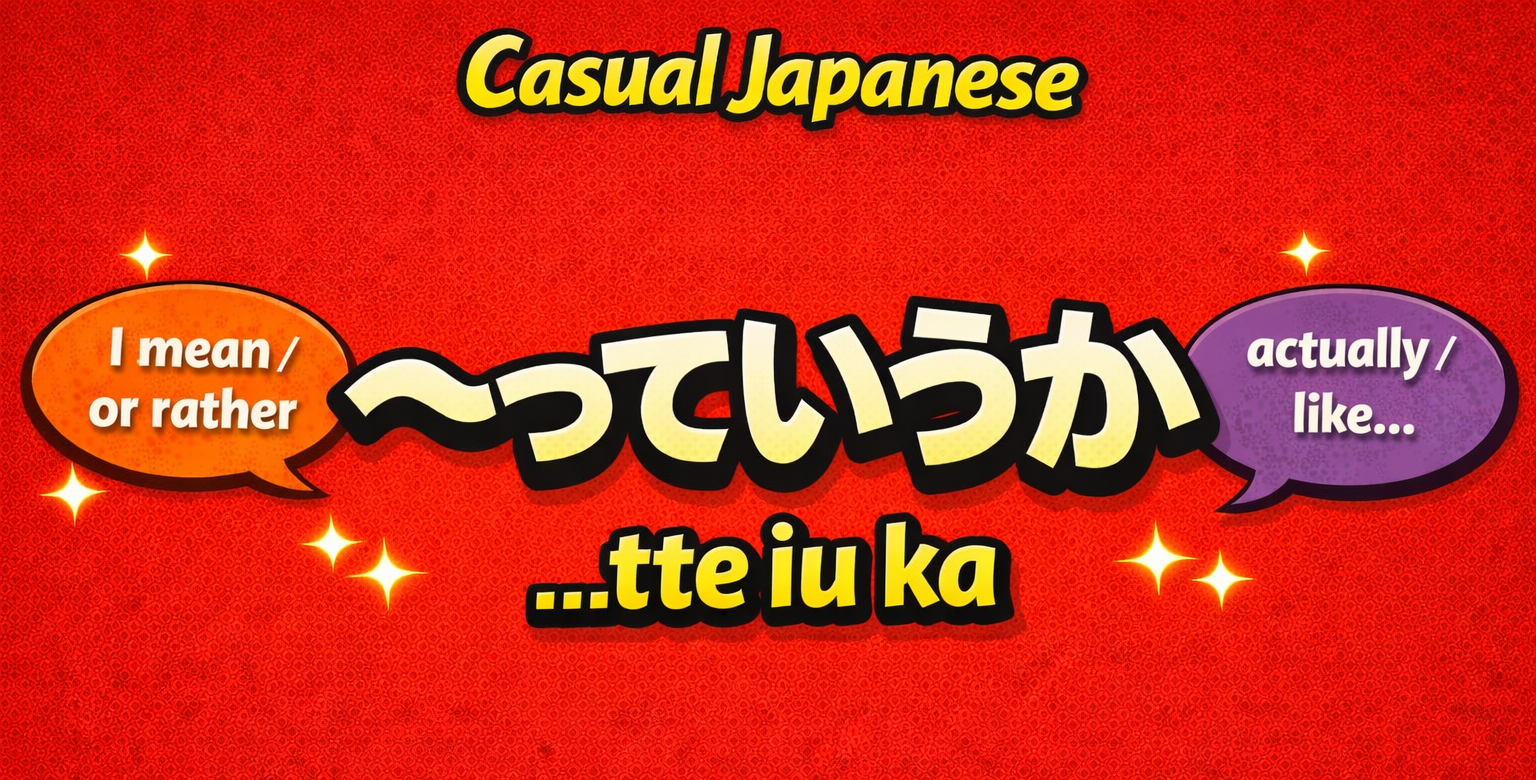
If you want to sound more natural in spoken Japanese, 「っていうか (tte iu ka)」 is absolutely essential.
Japanese people use it constantly in everyday conversation because it’s a convenient tool for:
-
correcting yourself mid-sentence
-
rephrasing what you said
-
softening an opinion
-
adding a casual “commentary”
-
changing direction in a conversation
Depending on context, 「っていうか (tte iu ka)」 can feel like:
-
“I mean…”
-
“or rather…”
-
“actually…”
-
“like…”
-
“more like…”
-
“to be honest…”
- 1) What 「っていうか (tte iu ka)」 means (Core Grammar Explanation)
- 2) Textbook Japanese vs Real-Life Spoken Japanese
- 3) Key nuance: 「っていうか (tte iu ka)」 is NOT logical writing
- 4) Mini Knowledge
- A) Sentence-start: 「っていうか… (tte iu ka…)」 (topic shift / correction)
- B) Rephrasing: 「AっていうかB」 (“more like…”)
- C) Using it to soften / self-correct
- D) 「っていうかさ」 / casual chatting style
- Quick Summary (for learners)
- Learn Japanese on Preply!
1) What 「っていうか (tte iu ka)」 means (Core Grammar Explanation)
「っていうか (tte iu ka)」 comes from the phrase:
-
「って言う (tte iu)」 = “to say / called”
-
「っていうか (tte iu ka)」 = “if I say it like that… / speaking of which…”
But in real casual Japanese, it’s rarely used literally. It functions as a conversational connector.
It mainly works in two ways:
Use A: Sentence-start 「っていうか… (tte iu ka…)」 (Topic shift / correction / interruption)
Used at the beginning of a sentence to mean:
-
“By the way…”
-
“Actually…”
-
“I mean…”
It often signals:
-
“I want to change what I said”
-
“I want to add something”
-
“I’m about to comment honestly”
Use B: Mid-sentence 「AっていうかB (A tte iu ka B)」 (Rephrasing / “rather than A, it’s B”)
This pattern is extremely common:
-
「AっていうかB」
Meaning:
“It’s not exactly A… it’s more like B.”
It’s perfect for:
-
describing relationships
-
describing vibes/labels
-
making jokes
-
making a strong impression without sounding too formal
Example:
-
「友達っていうか、もはやカップル」 (tomodachi tte iu ka, mohaya kappuru.)
= “They’re not just friends. They’re basically a couple.”
2) Textbook Japanese vs Real-Life Spoken Japanese
Textbook Japanese (more structured)
Textbooks often teach:
-
「言い換えると… (ii kaeru to…)」 (to rephrase)
-
「つまり… (tsumari…)」 (in other words)
-
「むしろ… (mushiro…)」 (rather)
-
「というより… (to iu yori…)」 (rather than)
These are correct but often feel:
-
too formal
-
too clean
-
too “written language”
Real spoken Japanese
In daily Japanese, people default to:
-
「っていうか (tte iu ka)」
Because it feels:
-
spontaneous
-
natural
-
conversational
-
“thinking out loud”
3) Key nuance: 「っていうか (tte iu ka)」 is NOT logical writing
English learners sometimes over-translate it as “or rather,” but 「っていうか (tte iu ka)」 is often NOT a logical connector.
Instead, it’s more like:
a live edit button for your speech.
It’s the Japanese equivalent of:
-
“wait”
-
“no actually”
-
“I mean”
-
“more like”
-
“okay but…”
4) Mini Knowledge
Difference: 「っていうか (tte iu ka)」 vs 「というより (to iu yori)」
Both can mean “rather than…,” but:
-
「というより (to iu yori)」 = more grammar-ish, careful, slightly formal
-
「っていうか (tte iu ka)」 = casual, spontaneous, very spoken
So:
-
「というより (to iu yori)」 works in writing and speeches
-
「っていうか (tte iu ka)」 works in real conversation
「っていうか (tte iu ka)」 can be a “softener”
You can say something harsh, then soften it with 「っていうか (tte iu ka)」:
-
「ムカつく。っていうか悲しい。」 (mukatsuku. tte iu ka kanashii.) = “I’m mad. No, actually… I’m just sad.”
This feels emotionally real and conversational.
「っていうかさ」 is extra native
Adding 「さ」 makes it even more casual and “chatty”:
-
「っていうかさ、聞いてよ。」 (tte iu ka sa, kiite yo.) = “Wait, listen.”
Very common combinations
「っていうか」 often pairs with:
-
「もう (mou)」 (seriously)
-
「さ (sa)」 (you know)
-
「なんか (nanka)」 (kinda)
5) Example Sentences (30 examples)
A) Sentence-start: 「っていうか… (tte iu ka…)」 (topic shift / correction)
1. っていうか、今何時?
っていうか、いまなんじ?
tte iu ka, ima nanji?
Actually, what time is it?
2. っていうか、それどこで買ったの?
っていうか、それどこでかったの?
tte iu ka, sore doko de katta no?
By the way, where did you buy that?
3. っていうか、聞いて。今日やばかった。
っていうか、きいて。きょうやばかった。
tte iu ka, kiite. kyou yabakatta.
Wait, listen. Today was crazy.
4. っていうか、まだ寝てないの?
っていうか、まだねてないの?
tte iu ka, mada nete nai no?
Wait, you still haven’t slept?
5. っていうか、この話やめない?
っていうか、このはなしやめない?
tte iu ka, kono hanashi yamenai?
Actually, can we stop this topic?
6. っていうか、なんで私がやるの?
っていうか、なんでわたしがやるの?
tte iu ka, nande watashi ga yaru no?
Wait, why do I have to do it?
7. っていうか、もう帰りたい。
っていうか、もうかえりたい。
tte iu ka, mou kaeritai.
Honestly, I want to go home already.
8. っていうか、それ普通に失礼じゃない?
っていうか、それふつうにしつれいじゃない?
tte iu ka, sore futsuu ni shitsurei janai?
Actually, isn’t that just rude?
9. っていうか、今日めっちゃ寒い。
っていうか、きょうめっちゃさむい。
tte iu ka, kyou meccha samui.
Actually, it’s super cold today.
10. っていうか、この店初めて来た。
っていうか、このみせはじめてきた。
tte iu ka, kono mise hajimete kita.
By the way, this is my first time coming here.
B) Rephrasing: 「AっていうかB」 (“more like…”)
11. あの2人、友達っていうか、もはやカップルだよね。
あのふたり、ともだちっていうか、もはやかっぷるだよね。
ano futari, tomodachi tte iu ka, mohaya kappuru da yo ne.
Those two aren’t just friends. They’re basically a couple.
12. この料理、おいしいっていうか、うますぎ。
このりょうり、おいしいっていうか、うますぎ。
kono ryouri, oishii tte iu ka, umasugi.
This food isn’t just good. It’s insanely good.
13. それ、謝罪っていうか、言い訳じゃん。
それ、しゃざいっていうか、いいわけじゃん。
sore, shazai tte iu ka, iiwake jan.
That’s not an apology, it’s an excuse.
14. 彼って優しいっていうか、甘いよね。
かれってやさしいっていうか、あまいよね。
kare tte yasashii tte iu ka, amai yo ne.
He’s not just kind… he’s too soft on people.
15. 今日の天気、暑いっていうか、痛い。
きょうのてんき、あついっていうか、いたい。
kyou no tenki, atsui tte iu ka, itai.
Today’s weather isn’t just hot… it hurts.
16. その服、かわいいっていうか、おしゃれ。
そのふく、かわいいっていうか、おしゃれ。
sono fuku, kawaii tte iu ka, oshare.
That outfit isn’t just cute, it’s stylish.
17. 私、緊張してるっていうか、震えてる。
わたし、きんちょうしてるっていうか、ふるえてる。
watashi, kinchou shiteru tte iu ka, furueteru.
I’m not just nervous… I’m shaking.
18. 彼、真面目っていうか、固すぎ。
かれ、まじめっていうか、かたすぎ。
kare, majime tte iu ka, katasugi.
He’s not just serious… he’s too rigid.
19. この映画、怖いっていうか、メンタルにくる。
このえいが、こわいっていうか、めんたるにくる。
kono eiga, kowai tte iu ka, mentaru ni kuru.
This movie isn’t just scary, it messes with you mentally.
20. それ、ミスっていうか、事故だよ。
それ、みすっていうか、じこだよ。
sore, misu tte iu ka, jiko da yo.
That’s not a mistake… that’s an accident.
C) Using it to soften / self-correct
21. 行けるよ。っていうか、たぶん行ける。
いけるよ。っていうか、たぶんいける。
ikeru yo. tte iu ka, tabun ikeru.
I can go. I mean… I can probably go.
22. 好きだよ。っていうか、大好き。
すきだよ。っていうか、だいすき。
suki da yo. tte iu ka, daisuki.
I like it. I mean… I love it.
23. 大丈夫。っていうか、全然大丈夫じゃない。
だいじょうぶ。っていうか、ぜんぜんだいじょうぶじゃない。
daijoubu. tte iu ka, zenzen daijoubu janai.
I’m fine. Actually… I’m not fine at all.
24. 分かった。っていうか、まだよく分かってない。
わかった。っていうか、まだよくわかってない。
wakatta. tte iu ka, mada yoku wakatte nai.
Got it. I mean… I don’t really get it yet.
25. できる。っていうか、やるしかない。
できる。っていうか、やるしかない。
dekiru. tte iu ka, yaru shika nai.
I can do it. I mean… I have no choice but to do it.
D) 「っていうかさ」 / casual chatting style
26. っていうかさ、今日むしろ私えらくない?
っていうかさ、きょうむしろわたしえらくない?
tte iu ka sa, kyou mushiro watashi erakunai?
Actually, isn’t it impressive that I even showed up today?
27. っていうかさ、今週長すぎ。
っていうかさ、こんしゅうながすぎ。
tte iu ka sa, konshuu nagasugi.
Seriously, this week is way too long.
28. っていうかさ、それ先に言ってよ。
っていうかさ、それさきにいってよ。
tte iu ka sa, sore saki ni itte yo.
Like… you should’ve told me earlier.
29. っていうかさ、何でそんなに詳しいの?
っていうかさ、なんでそんなにくわしいの?
tte iu ka sa, nande sonna ni kuwashii no?
Wait, why do you know so much about that?
30. っていうかさ、今日の私、がんばった。
っていうかさ、きょうのわたし、がんばった。
tte iu ka sa, kyou no watashi, ganbatta.
Honestly, I did my best today.
Quick Summary (for learners)
-
「っていうか (tte iu ka)」 is one of the most essential spoken expressions in Japanese.
-
It’s used for:
-
topic shifts (“actually / by the way”)
-
corrections (“I mean”)
-
rephrasing (“more like…”)
-
-
Two key patterns:
-
Sentence-start: 「っていうか、… (tte iu ka, …)」
-
Rephrasing: 「AっていうかB (A tte iu ka B)」
-

Learn Japanese on Preply!
Preply is a very user-friendly language-learning platform, and I use it both as a tutor and as a student. I’m currently taking English, German, and Chinese lessons on Preply myself, so I can confidently recommend it from personal experience.
One of the things I like most about Preply is that it’s not a one-time booking system, but a subscription-based platform. Because you’ve already paid for lessons, it’s easier to stay motivated and think, “I’ve paid for it, so I should keep going!” (This actually helps a lot!)
At the beginning, you decide how many lessons you want to take per week. After that, you can book lessons on the days that suit your schedule, or you can set a fixed weekly lesson on the same day and time. You can also reschedule or cancel up to one day in advance, so it works well even for busy learners.
Preply also has a wide variety of teachers, including many professional tutors with qualifications and extensive experience, as well as friendly and affordable tutors for casual learners. Japanese tutors on Preply are generally very serious and dedicated, so most of them have excellent ratings (many are 5-star teachers!).
Find a tutor who matches your learning style, and enjoy studying Japanese!
If you book a trial lesson through this link, you’ll get 30% off.
Click here👇

I am a native Japanese tutor with over 1,500 lessons taught across multiple platforms.
I majored in English at university and graduated, and I have since returned to university to study linguistics more broadly.
Related posts:
 Wakaru vs Shiru Difference: Why “Wakaru!” Feels Warm but “Shiru” Often Doesn’t
 Japanese Casual Expression: 「とか (toka)」 (A Super Common Colloquial “and stuff / like”)
 Japanese Casual Expression: 〜じゃん (…jan)
 Japanese Casual Expression: 〜さ (…sa) – Use with caution! (Friendly, but risky)
 Japanese Casual Expression: 「〜っぽい (ppoi)」 (The Native Shortcut for “-ish / seems like / has the vibe of”)
 Japanese Casual Expression: 〜っちゃ〜する (…ccha …suru)
 The Japanese Verb “悩む” (Nayamu): Meaning, Usage, and Why It’s Hard to Translate
 V-masu or V-n desu? When and Why Japanese Uses “んです” (n desu)