Hi! I’m Mai-sensei, a native Japanese tutor.
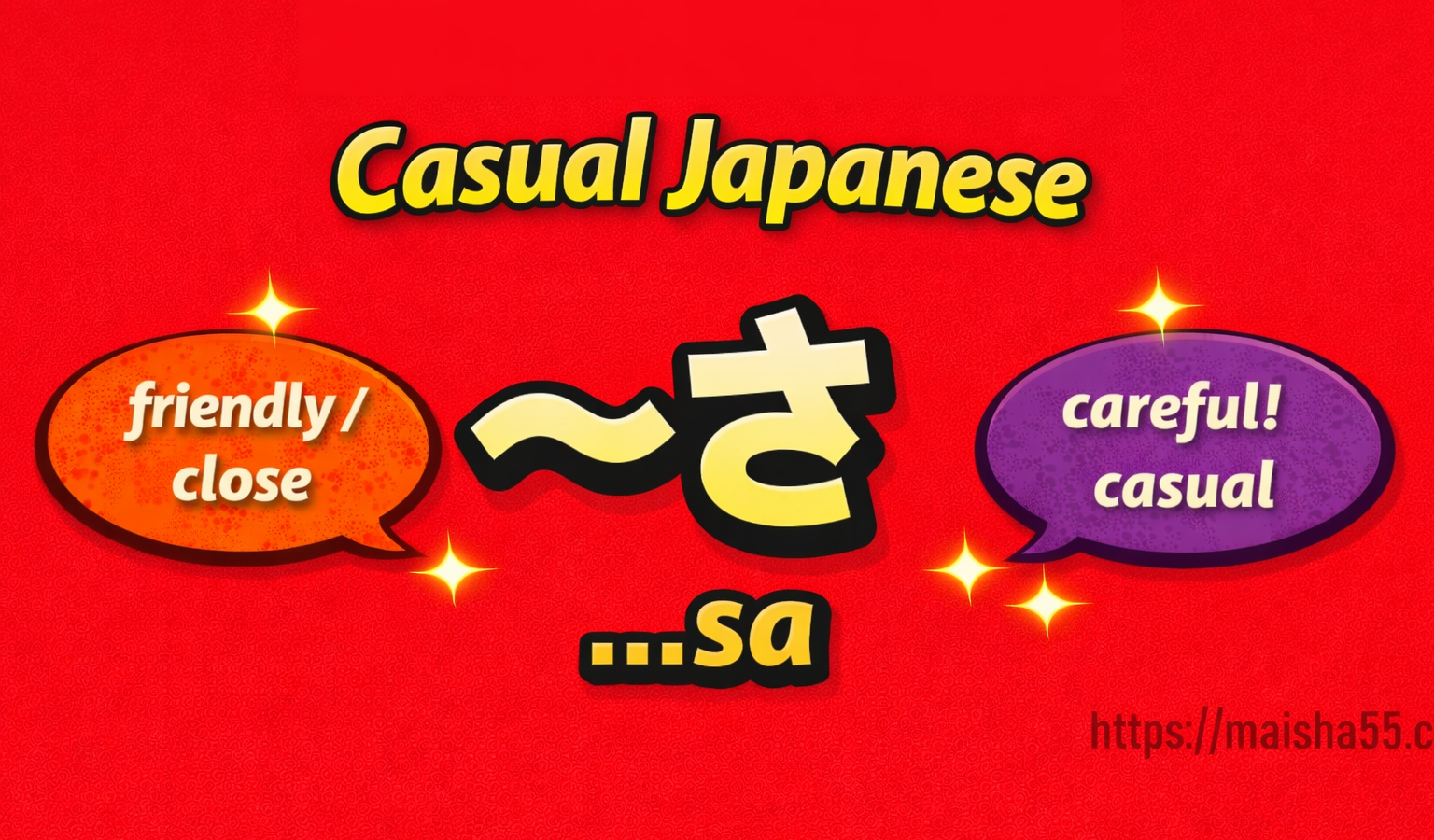
In casual Japanese, 〜さ (…sa) is a super common speech habit. It can sound friendly, relaxed, and natural among close friends.
However, 〜さ (…sa) is also one of those expressions that advanced learners accidentally overuse, especially as a filler like あのさ〜 (ano sa) or えっとさ〜 (etto sa). When used with someone you’re not close to, it may sound too familiar or even rude.
This article focuses on conversational 〜さ (…sa) used in casual speech.
(It does NOT cover storytelling とさ (…to sa) such as 「むかしむかし…しあわせにくらしましたとさ」, which is a different usage.)
1) What is 〜さ (…sa)?
Learners often search for this expression as:
-
“Japanese ending sa”
-
“Japanese filler sa”
-
“What does sa mean in Japanese?”
-
“sa at the end of sentences in Japanese”
In real spoken Japanese, 〜さ (…sa) is mainly used as:
-
A filler used to keep the conversation going
-
A closeness marker that makes speech feel informal and friendly
In other words, 〜さ (…sa) is less about literal meaning and more about social tone.
2) When should you NOT use 〜さ (…sa)?
A simple rule:
If you want to sound polite, professional, or neutral, avoid 〜さ (…sa).
Because it strongly implies:
-
“we’re close”
-
“we can speak casually”
-
“I’m speaking casually as myself”
So it may not fit with:
-
clients / customers
-
teachers / supervisors
-
senpai in formal settings
-
strangers or people you just met
[Caution]
It can sometimes be used together with polite expressions, but it often sounds unnatural, so I don’t recommend it. In some cases, it may even sound grammatically incorrect.
3) Textbook Japanese vs Real-life Japanese
Textbook-style fillers and connectors:
-
あの… (ano…) = um…
-
えっと… (etto…) = uh…
-
その… (sono…) = well…
-
ところで… (tokoro de…) = by the way…
-
実は… (jitsu wa…) = actually…
Real casual Japanese often adds さ (…sa):
-
あのさ (ano sa) = hey, listen…
-
えっとさ (etto sa) = um, like…
-
なんかさ (nanka sa) = like, you know…
-
ていうかさ (tte iu ka sa) = I mean…
These sound very native, but they should be treated as “close-friend language.”
4) Mini Knowledge
A helpful way to understand 〜さ (…sa):
It works like a “closeness tag.”
It makes the conversation feel informal and friendly, like you’re speaking without a filter.
That’s why it appears a lot in:
-
casual storytelling
-
complaints
-
teasing / joking
-
emotional reactions
Very common patterns:
-
あのさ (ano sa) = “hey, listen…”
-
えっとさ (etto sa) = “uh, like…”
-
なんかさ (nanka sa) = “like, you know…”
-
ていうかさ (tte iu ka sa) = “I mean…”
Polite-safe alternatives (recommended):
-
あの… (ano…)
-
えっと… (etto…)
-
すみません、ちょっと… (sumimasen, chotto…)
-
ところで… (tokoro de…)
-
実は… (jitsu wa…)
5) Example Sentences
A) Filler / attention-getting (very common)
-
あのさ、ちょっと聞いて。
ano sa, chotto kiite.
Hey, listen for a second. -
えっとさ、それでどうなったの?
etto sa, sore de dou natta no?
Uh, so what happened then? -
なんかさ、今日は疲れた。
nanka sa, kyou wa tsukareta.
Like… I’m tired today. -
ていうかさ、それおかしくない?
tte iu ka sa, sore okashikunai?
I mean, isn’t that weird? - まあさ、そういう日もあるよ。
Maa sa, sou iu hi mo aru yo.
Well, you have days like that too. - なんていうかさ、言葉にするのが難しいんだよね。
Nante iu ka sa, kotoba ni suru no ga muzukashii n da yo ne.
How should I put it… it’s hard to put into words.
B) 〜なんだけどさ (…nan dakedo sa)
-
相談があるんだけどさ。
soudan ga aru n dakedo sa.
So… I have something to talk to you about. -
今日ちょっとお願いがあるんだけどさ。
kyou chotto onegai ga aru n dakedo sa.
I have a small favor to ask, you know. -
実はさ、言いたいことがあるんだけどさ。
jitsu wa sa, iitai koto ga aru n dakedo sa.
Actually, there’s something I want to say. -
これ言いにくいんだけどさ…。
kore iinikui n dakedo sa…
This is kind of hard to say, but… -
ちょっと聞いてほしいんだけどさ。
chotto kiite hoshii n dakedo sa.
I want you to hear me out, you know. -
ごめん、今から行くんだけどさ、ちょっと遅れる。
gomen, ima kara iku n dakedo sa, chotto okureru.
Sorry, I’m heading there now, but I’ll be a bit late.
C) Close-friend tone: さ inside sentences
-
それさ、前に話してたやつ?
sore sa, mae ni hanashiteta yatsu?
Is that the thing you talked about before? -
さっきさ、変な人いたよね。
sakki sa, hen na hito ita yo ne.
Earlier there was a weird person, right? -
だからさ、そういうことじゃないの。
dakara sa, sou iu koto janai no.
That’s not what I mean, you know. -
こっちさ、結構大変だったんだよ。
こっちさ、けっこうたいへんだったんだよ。
kocchi sa, kekkou taihen datta n da yo.
Things were pretty tough on my side, you know. - でもさ、それってちょっとおかしくない?
demo sa, sore tte chotto okashiku nai?
But like… isn’t that a bit weird? - そういえばさ、昨日言ってた話どうなった?
sou ieba sa, kinou itteta hanashi dou natta?
By the way… what happened with that thing you mentioned yesterday?

Learn Japanese on Preply!
Preply is a very user-friendly language-learning platform, and I use it both as a tutor and as a student. I’m currently taking English, German, and Chinese lessons on Preply myself, so I can confidently recommend it from personal experience.
One of the things I like most about Preply is that it’s not a one-time booking system, but a subscription-based platform. Because you’ve already paid for lessons, it’s easier to stay motivated and think, “I’ve paid for it, so I should keep going!” (This actually helps a lot!)
At the beginning, you decide how many lessons you want to take per week. After that, you can book lessons on the days that suit your schedule, or you can set a fixed weekly lesson on the same day and time. You can also reschedule or cancel up to one day in advance, so it works well even for busy learners.
Preply also has a wide variety of teachers, including many professional tutors with qualifications and extensive experience, as well as friendly and affordable tutors for casual learners. Japanese tutors on Preply are generally very serious and dedicated, so most of them have excellent ratings (many are 5-star teachers!).
Find a tutor who matches your learning style, and enjoy studying Japanese!
If you book a trial lesson through this link, you’ll get 30% off.
Click here👇