Hi! I’m Mai-sensei, a native Japanese tutor.
I offer online Japanese lessons. More details are available at the end of this article.
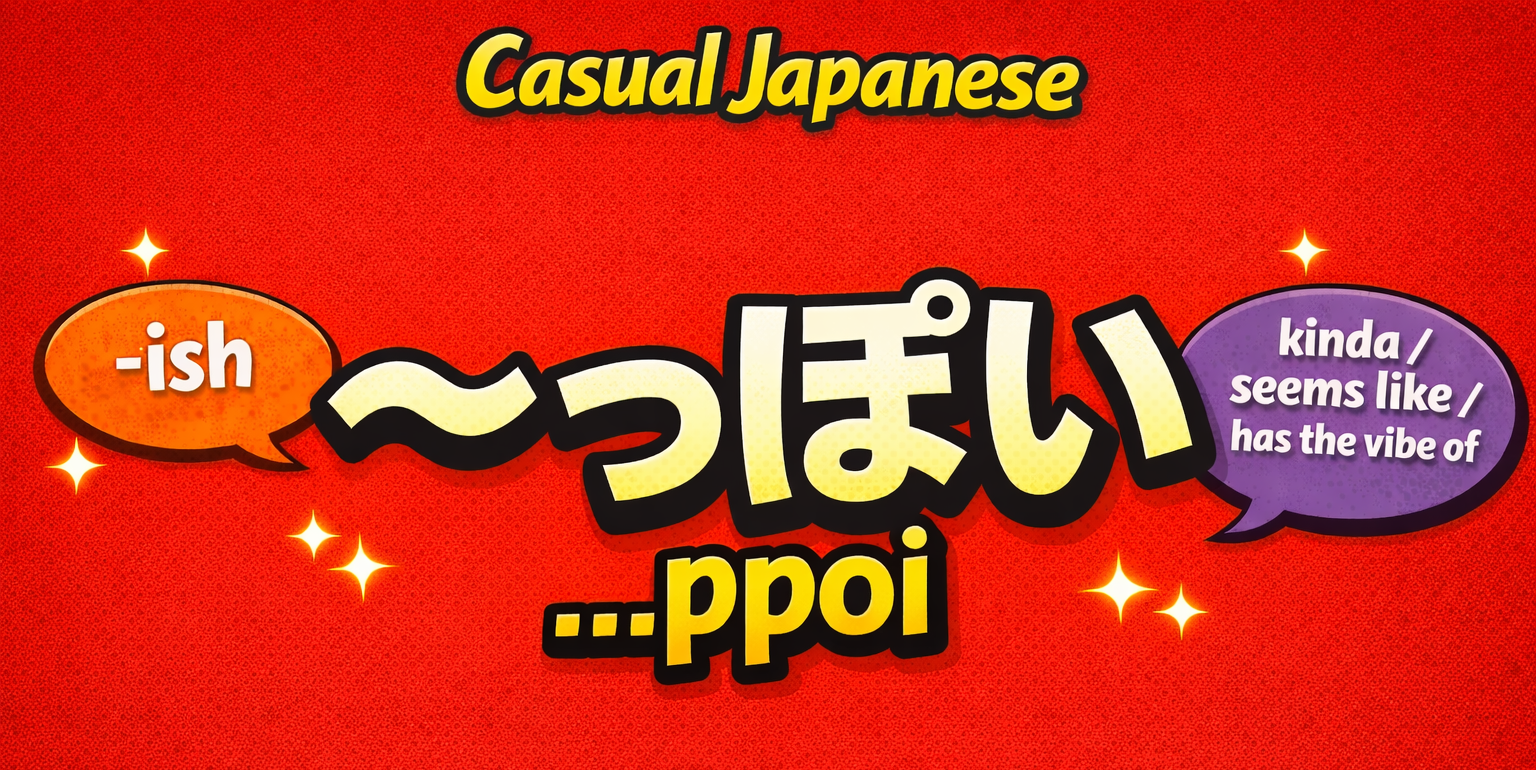
What does 〜っぽい (…ppoi) mean?
〜っぽい (…ppoi) is a very common casual Japanese expression used to describe something that feels, looks, or has the vibe of something else.
Depending on context, it can mean:
- “-ish”
- “kind of”
- “seems like”
- “has the vibe of”
It’s widely used in spoken Japanese and casual writing.
Comparison with textbook Japanese
In textbooks, you often learn expressions like:
- 〜のようだ (… no you da)
- 〜みたいだ (… mitai da)
〜っぽい (…ppoi) is more casual and subjective.
It often reflects the speaker’s impression rather than an objective judgment.
Common patterns of 〜っぽい (…ppoi)
・Noun + っぽい (…ppoi)
・Verb (casual form) + っぽい (…ppoi)
・Adjective stem + っぽい (…ppoi)
Some 〜っぽい forms have become fixed adjectives, while others are created freely in conversation.
Fixed adjectives with 〜っぽい (…ppoi)
These are established words you’ll often hear:
・忘れっぽい (wasureppoi) – forgetful
・怒りっぽい (okorippoi) – easily irritated
・飽きっぽい (akippoi) – gets bored easily
・子どもっぽい (kodomoppoi) – childish
〜っぽい (…ppoi) as a soft guess or suggestion
When used at the end of a sentence, 〜っぽい often sounds gentle and indirect.
It’s useful for avoiding strong statements.
Cultural note
Japanese speakers often use 〜っぽい (…ppoi) to soften opinions or avoid sounding too direct.
This makes it extremely common in daily conversation.
Example sentences
・今日は雨っぽいね。
Kyou wa ameppoi ne.
It seems like rain today.
・この曲、ちょっとビートルズっぽいよね。
Kono kyoku, chotto Biitoruzuppoi yo ne.
This song feels kind of Beatles-like.
・彼、最近疲れてるっぽい。
Kare, saikin tsukareteruppoi.
He seems tired lately.
・その話、本当っぽいけどまだ分からない。
Sono hanashi, hontouppoi kedo mada wakaranai.
That story sounds true, but I’m not sure yet.
・明日は雪っぽいから気をつけて。
Ashita wa yukippoi kara ki wo tsukete.
It looks like snow tomorrow, so be careful.
・このカフェ、韓国っぽい雰囲気だね。
Kono kafe, Kankokuppoi funiki da ne.
This café has a Korean vibe.
・今日はなんか元気ないっぽい。
Kyou wa nanka genki naippoi.
You seem kind of low-energy today.
・その服、春っぽい色だね。
Sono fuku, haruppoi iro da ne.
Those clothes have a spring-like color.
・彼女、怒ってるっぽいから後で話そう。
Kanojo, okotteruppoi kara ato de hanasou.
She seems angry, so let’s talk later.
・この問題、簡単っぽいけど意外と難しい。
Kono mondai, kantanppoi kedo igai to muzukashii.
This problem looks easy, but it’s harder than it seems.
・最近、忘れっぽくなった。
Saikin, wasureppoku natta.
I’ve become more forgetful lately.
・あの映画、ホラーっぽいけど大丈夫?
Ano eiga, horaappoi kedo daijoubu?
That movie looks like a horror film. Are you okay with that?
・彼、子どもっぽいところがあるよね。
Kare, kodomoppoi tokoro ga aru yo ne.
He has a childish side.
・今日はもう帰りたいっぽい気分。
Kyou wa mou kaeritaippoi kibun.
I kind of feel like going home already.
・この色、夏っぽくて好き。
Kono iro, natsuppoku te suki.
I like this color. It feels summery.
・あの店、閉まってるっぽい。
Ano mise, shimatteruppoi.
That shop looks closed.
・彼女、外国人っぽいね。
Kanojo, gaikokujinppoi ne.
She looks like a foreigner.
・その説明、ちょっと嘘っぽい。
Sono setsumei, chotto usoppoi.
That explanation sounds a bit fake.
・最近、飽きっぽくなってきた。
Saikin, akippoku natte kita.
I’ve been getting bored easily lately.
・この写真、プロっぽいね。
Kono shashin, puroppoi ne.
This photo looks professional.
・彼、もう諦めてるっぽい。
Kare, mou akirameteruppoi.
He seems like he’s already given up.
・この街、夜になると大人っぽくなるね。
Kono machi, yoru ni naru to otonappoku naru ne.
This town feels more mature at night.
・今日は早く終わるっぽい。
Kyou wa hayaku owaruppoi.
It looks like we’ll finish early today.
・その人、有名人っぽいけど誰?
Sono hito, yuumeijinppoi kedo dare?
That person looks famous. Who is it?
・このケーキ、手作りっぽい味だね。
Kono keeki, tezukurippoi aji da ne.
This cake tastes homemade.
Learn Japanese on Preply!
Preply is a very user-friendly language-learning platform, and I use it both as a tutor and as a student. I’m currently taking English, German, and Chinese lessons on Preply myself, so I can confidently recommend it from personal experience.
One of the things I like most about Preply is that it’s not a one-time booking system, but a subscription-based platform. Because you’ve already paid for lessons, it’s easier to stay motivated and think, “I’ve paid for it, so I should keep going!” (This actually helps a lot!)
At the beginning, you decide how many lessons you want to take per week. After that, you can book lessons on the days that suit your schedule, or you can set a fixed weekly lesson on the same day and time. You can also reschedule or cancel up to one day in advance, so it works well even for busy learners.
Preply also has a wide variety of teachers, including many professional tutors with qualifications and extensive experience, as well as friendly and affordable tutors for casual learners. Japanese tutors on Preply are generally very serious and dedicated, so most of them have excellent ratings (many are 5-star teachers!).
Find a tutor who matches your learning style, and enjoy studying Japanese!
If you book a trial lesson through this link, you’ll get 30% off.
Click here👇