
Hi! I’m Mai-sensei, a native Japanese tutor.
I’m currently accepting online Japanese lessons. Details are written at the end of this article.
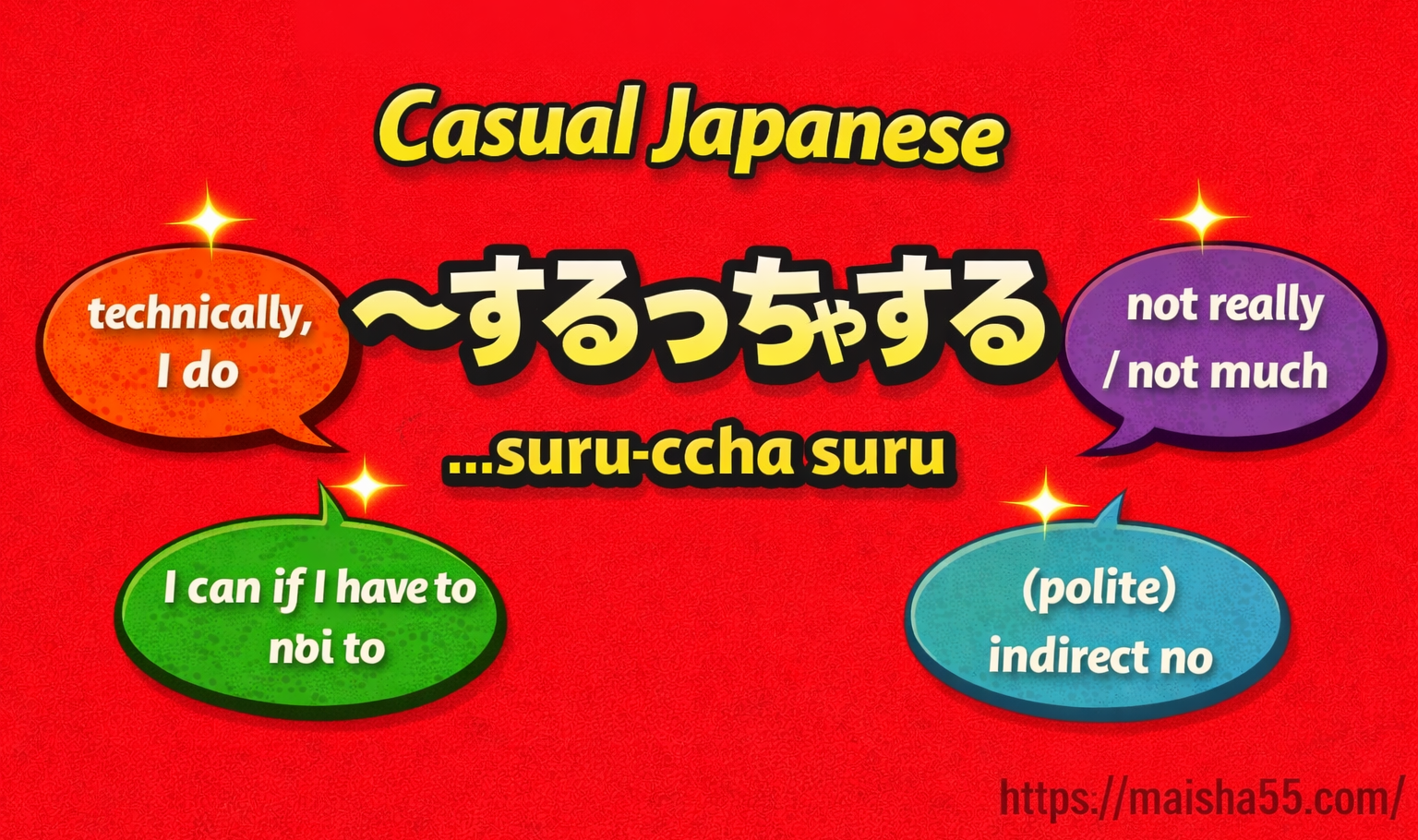
What does 〜っちゃ〜する mean?
〜っちゃ〜する is a casual, spoken pattern that means:
- “I do (if you put it that way)… but…”
- “I can (technically)… but…”
- “Yes, but only to a limited degree” / “Not really” / sometimes “(Soft) no”
It often sounds like you’re agreeing a little, then adding a but to adjust expectations.
Where does 〜っちゃ come from?
Many learners notice this: 〜っちゃ is very close in meaning to 〜と言えば (to ieba) and sometimes 〜には〜 (ni wa).
- 飲むっちゃ飲むけど ≈ 飲むと言えば飲むけど (nomu to ieba nomu kedo)
- 飲めるっちゃ飲めるけど ≈ 飲めると言えば飲めるけど / 飲めるには飲めるけど (nomeru ni wa nomeru kedo)
Two key types you mentioned
1) Habit / “I do, but not that much”
飲むっちゃ飲むけど (nomuccha nomu kedo)
“I mean, I do drink… but not a lot / not that often.”
2) Ability (potential form) / “I can, but…”
飲めるっちゃ飲めるけど (nomeruccha nomeru kedo)
“I can drink (if I had to)… but I don’t really like it / I usually don’t.”
This is great practice for the potential form (可能形 / kanoukei): 飲める, 行ける, 会える, できる, etc.
Why Japanese people use it for “indirect refusal”
Depending on context, 〜っちゃ〜する can be:
- a simple “somewhat / not much” statement, or
- a very Japanese, soft, roundabout “no.”
Example vibe:
- 週末、会えるっちゃ会えるんだけど… (shuumatsu aeruccha aerun dakedo…)
This often implies: “I could, but… (I’d rather not / I’m tired / I’m busy).”
Basic patterns (super common)
- Verb (dictionary): VるっちゃVるけど
- Potential: VれるっちゃVれるけど
- Noun / adjective: NっちゃNだけど, AdjっちゃAdjだけど
(Casual and very spoken)
Example sentences (Kanji, Romaji, English)
・お酒、飲むっちゃ飲むけど、毎日は飲まないよ。
Osake, nomuccha nomu kedo, mainichi wa nomanai yo.
“I drink, I guess, but I don’t drink every day.”
・お酒、飲めるっちゃ飲めるけど、別に好きじゃない。
Osake, nomeruccha nomeru kedo, betsuni suki ja nai.
“I can drink, technically, but I don’t really like it.”
・週末、会えるっちゃ会えるんだけど、最近ちょっと忙しくてね。
Shuumatsu, aeruccha aerun dakedo, saikin chotto isogashikute ne.
“I could meet this weekend, but I’ve been a bit busy lately.”
・行くっちゃ行くけど、長居はできない。
Ikuccha iku kedo, nagai wa dekinai.
“I’ll go, but I can’t stay long.”
・行けるっちゃ行けるけど、体力がもつかな…。
Ikeruccha ikeru kedo, tairyoku ga motsu kana…
“I can go, but I’m not sure I have the energy…”
・買うっちゃ買うけど、今日はやめとく。
Kauccha kau kedo, kyou wa yametoku.
“I might buy it, but not today.”
・できるっちゃできるけど、今すぐは無理。
Dekiruccha dekiru kedo, ima sugu wa muri.
“I can do it, but not right now.”
・分かるっちゃ分かるけど、説明するのが難しい。
Wakaruccha wakaru kedo, setsumei suru no ga muzukashii.
“I kind of get it, but it’s hard to explain.”
・知ってるっちゃ知ってるけど、詳しくはないよ。
Shitteruccha shitteru kedo, kuwashiku wa nai yo.
“I know it, but I don’t know it well.”
・見たっちゃ見たけど、最後までは見てない。
Mitaccha mita kedo, saigo made wa mite nai.
“I watched it, but I didn’t watch it to the end.”
・食べるっちゃ食べるけど、辛いのは苦手。
Taberuccha taberu kedo, karai no wa nigate.
“I eat it, but I’m not good with spicy food.”
・作れるっちゃ作れるけど、時間かかるよ。
Tsukureruccha tsukureru kedo, jikan kakaru yo.
“I can make it, but it takes time.”
・話せるっちゃ話せるけど、まだ自信ない。
Hanaseruccha hanaseru kedo, mada jishin nai.
“I can speak it, but I’m not confident yet.”
・読めるっちゃ読めるけど、漢字は遅い。
Yomeruccha yomeru kedo, kanji wa osoi.
“I can read it, but I’m slow with kanji.”
・書けるっちゃ書けるけど、きれいじゃない。
Kakeruccha kakeru kedo, kirei ja nai.
“I can write it, but it’s not neat.”
・好きっちゃ好きだけど、毎日は聞かない。
Sukiccha suki dakedo, mainichi wa kikanai.
“I like it, but I don’t listen to it every day.”
・嫌いっちゃ嫌いだけど、食べられる。
Kiraiccha kirai dakedo, taberareru.
“I don’t like it, but I can eat it.”
・幸せっちゃ幸せだけど、お金がないんだよね…。
Shiawaseccha shiawase dakedo, okane ga nai n da yo ne…
“I’m happy, I guess… but I’m broke…”
・元気っちゃ元気だけど、今日は休みたい。
Genkiccha genki dakedo, kyou wa yasumitai.
“I’m okay, but I want to rest today.”
・暇っちゃ暇だけど、外に出る気がしない。
Himaccha hima dakedo, soto ni deru ki ga shinai.
“I’m free, but I don’t feel like going out.”
・大丈夫っちゃ大丈夫だけど、ちょっと不安。
Daijoubuccha daijoubu dakedo, chotto fuan.
“I’m probably fine, but I’m a bit worried.”
・本物っちゃ本物だけど、安いやつだよ。
Honmonoccha honmono dakedo, yasui yatsu da yo.
“It’s real, but it’s a cheap one.”
・プロっちゃプロだけど、まだ新人。
Puroccha puro dakedo, mada shinjin.
“I’m a pro, but I’m still new.”
・友達っちゃ友達だけど、そんなに話さない。
Tomodachiccha tomodachi dakedo, sonnani hanasanai.
“We’re friends, but we don’t talk that much.”
・恋人っちゃ恋人だけど、まだ秘密。
Koibitoccha koibito dakedo, mada himitsu.
“We’re kind of dating, but it’s still a secret.”
・参加するっちゃ参加するけど、遅れるかも。
Sankasuruccha sankasuru kedo, okureru kamo.
“I’ll join, but I might be late.”
・手伝うっちゃ手伝うけど、少しだけね。
Tetsudauccha tetsudau kedo, sukoshi dake ne.
“I’ll help, but only a little.”
・連絡するっちゃするけど、忘れてたらごめん。
Renrakusuruccha suru kedo, wasuretetara gomen.
“I’ll message you… but sorry if I forget.”
・また行くっちゃ行くけど、次は未定。
Mata ikuccha iku kedo, tsugi wa mitei.
“I’ll go again, but I don’t know when.”
・それ、欲しいっちゃ欲しいけど、今月は節約中。
Sore, hoshiccha hoshii kedo, kongetsu wa setsuyakuchuu.
“I want it, but I’m saving money this month.”
Quick learning tip
If you want to sound natural, keep it casual and spoken. This pattern is common in conversation, especially when you want to be honest without sounding too direct.
Learn Japanese on Preply!
Preply is a very user-friendly language-learning platform, and I use it both as a tutor and as a student. I’m currently taking English, German, and Chinese lessons on Preply myself, so I can confidently recommend it from personal experience.
One of the things I like most about Preply is that it’s not a one-time booking system, but a subscription-based platform. Because you’ve already paid for lessons, it’s easier to stay motivated and think, “I’ve paid for it, so I should keep going!” (This actually helps a lot!)
At the beginning, you decide how many lessons you want to take per week. After that, you can book lessons on the days that suit your schedule, or you can set a fixed weekly lesson on the same day and time. You can also reschedule or cancel up to one day in advance, so it works well even for busy learners.
Preply also has a wide variety of teachers, including many professional tutors with qualifications and extensive experience, as well as friendly and affordable tutors for casual learners. Japanese tutors on Preply are generally very serious and dedicated, so most of them have excellent ratings (many are 5-star teachers!).
Find a tutor who matches your learning style, and enjoy studying Japanese!
If you book a trial lesson through this link, you’ll get 30% off.
Click here👇