
Hi! I’m Mai-sensei, a native Japanese tutor.
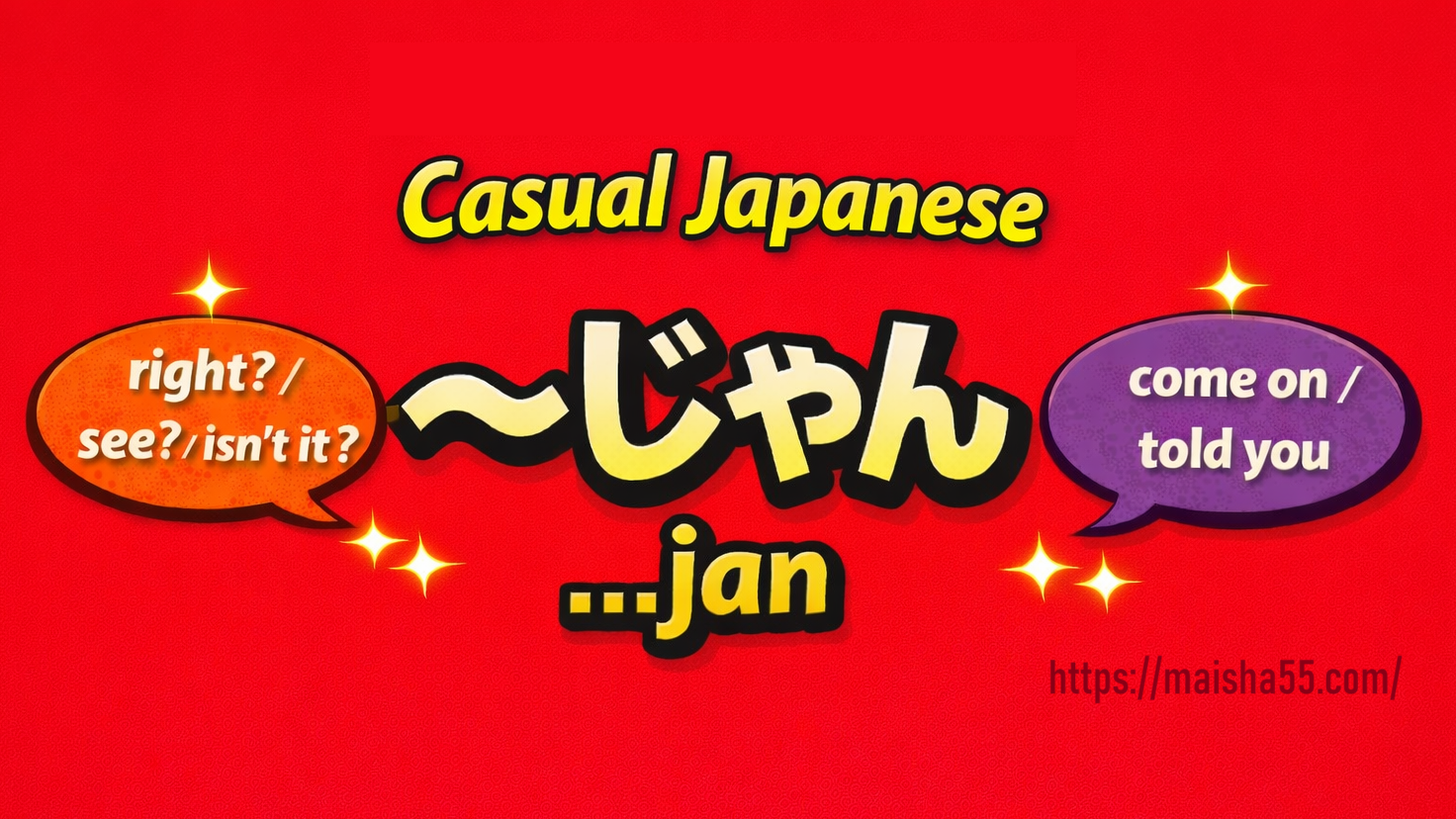
〜じゃん (…jan) is one of the most common spoken endings in casual Japanese. You’ll hear it everywhere: friends chatting, couples bickering, coworkers whispering, people reacting to videos, and basically any moment where someone wants to say “See?”, “Told you”, “Right?”, or “Come on”.
At its core, 〜じゃん (…jan) is a casual way to:
- point out something obvious
- confirm shared knowledge
- push for agreement
- lightly tease or complain
- emphasize “that’s exactly what I mean”
It can sound friendly, playful, or slightly confrontational depending on tone.
1) What 〜じゃん (…jan) means (Core Grammar Explanation)
〜じゃん (…jan) is a colloquial contraction of 〜じゃない (…ja nai).
In conversation, it often functions like a tag at the end of a sentence.
Very roughly, it can map to:
- “right?”
- “isn’t it?”
- “see?”
- “come on”
- “told you”
- “obviously”
- “that’s what I’m saying”
Common patterns:
- Noun + じゃん
- な-adjective + じゃん
- い-adjective + じゃん
- Verb (plain form) + じゃん
- Phrase + じゃん
2) Textbook Japanese vs Real-Life Spoken Japanese (Textbook vs. Real life)
Textbooks usually emphasize 〜じゃないですか (…ja nai desu ka) as a “confirmation” pattern.
- きれいじゃないですか。 (kirei ja nai desu ka.) = It’s beautiful, isn’t it?
But in real casual speech, people use 〜じゃん constantly:
- きれいじゃん。 (kirei jan.) = See, it’s pretty.
Textbook-style 〜じゃないですか (…ja nai desu ka) can sound:
- more polite
- more formal
- more “presentational”
Spoken 〜じゃん (…jan) sounds:
- casual
- quick
- emotionally loaded
- very native
3) Key nuance: 〜じゃん (…jan) is about “shared context”
〜じゃん (…jan) often assumes:
- “you already know this”
- “this is obvious”
- “we agree on this, right?”
That’s why it can feel pushy if used with strangers or in formal situations.
Tone matters a lot:
- soft tone: friendly confirmation
- sharp tone: complaint / accusation
- playful tone: teasing
4) Mini Knowledge
Difference: 〜じゃん (…jan) vs 〜でしょ (…desho)
Both can mean “right?”, but they feel different.
- 〜じゃん (…jan): points to something “obvious / already true / you see?”
- 〜でしょ (…desho): “right?” with stronger expectation that the other person agrees
〜じゃん (…jan) also works great for reactions:
- すごいじゃん (sugoi jan) = That’s awesome!
- いいじゃん (ii jan) = Nice!
Common derived forms (very spoken):
- じゃん? (…jan?) rising intonation: “right?” / “isn’t it?”
- じゃん! (…jan!) exclamation: emphasis
- じゃんか (…jan ka): rougher / more assertive (often masculine)
- じゃんね (…jan ne): softer, inviting agreement
5) Example Sentences (30 examples)
A) Simple “right? / see? / isn’t it?” uses
- 今日寒いじゃん。
きょう さむいじゃん。
kyou samui jan.
It’s cold today, right? - それ、前も言ったじゃん。
それ、まえも いったじゃん。
sore, mae mo itta jan.
I told you that before, didn’t I? - もう時間ないじゃん。
もう じかん ないじゃん。
mou jikan nai jan.
We don’t have time, you know? - ここ、静かじゃん。
ここ、しずかじゃん。
koko, shizuka jan.
It’s quiet here, isn’t it? - それ、かわいいじゃん。
それ、かわいいじゃん。
sore, kawaii jan.
That’s cute, right? - 今の、めっちゃ良かったじゃん。
いまの、めっちゃ よかったじゃん。
ima no, meccha yokatta jan.
That was really good, see? - ほら、やっぱりそうだったじゃん。
ほら、やっぱり そうだったじゃん。
hora, yappari sou datta jan.
See? I knew it. - その服、似合ってるじゃん。
そのふく、にあってるじゃん。
sono fuku, niatteru jan.
That outfit suits you, doesn’t it? - 今日は休みじゃん。
きょうは やすみじゃん。
kyou wa yasumi jan.
Today’s a day off, right? - それ、普通にすごいじゃん。
それ、ふつうに すごいじゃん。
sore, futsuu ni sugoi jan.
That’s honestly amazing.
B) “Come on / that’s the point” (slightly pushy)
- だって無理じゃん。
だって むりじゃん。
datte muri jan.
Come on, it’s impossible. - 今さら言われても困るじゃん。
いまさら いわれても こまるじゃん。
imasara iwarete mo komaru jan.
You can’t tell me that now. - それ言うの遅いじゃん。
それ いうの おそいじゃん。
sore iu no osoi jan.
You’re late telling me that. - 約束したじゃん。
やくそくしたじゃん。
yakusoku shita jan.
But you promised. - それはさすがにひどいじゃん。
それは さすがに ひどいじゃん。
sore wa sasuga ni hidoi jan.
That’s seriously harsh. - もう終わった話じゃん。
もう おわった はなしじゃん。
mou owatta hanashi jan.
That’s already over. - だから言ったじゃん。
だから いったじゃん。
dakara itta jan.
That’s what I said. - それ、逆に失礼じゃん。
それ、ぎゃくに しつれいじゃん。
sore, gyaku ni shitsurei jan.
That’s rude, actually. - それ、誰でも分かるじゃん。
それ、だれでも わかるじゃん。
sore, daredemo wakaru jan.
Anyone can tell that. - それやったら怒られるじゃん。
それ やったら おこられるじゃん。
sore yattara okorareru jan.
If you do that, you’ll get in trouble.
C) Friendly reactions and praise
- いいじゃん!それで行こう。
いいじゃん!それで いこう。
ii jan! sore de ikou.
Nice! Let’s do that. - めっちゃいいじゃん。
めっちゃ いいじゃん。
meccha ii jan.
That’s really good! - それ、センスあるじゃん。
それ、せんす あるじゃん。
sore, sensu aru jan.
You’ve got taste. - できてるじゃん!すごい。
できてるじゃん!すごい。
dekiteru jan! sugoi.
You did it! Awesome. - その発想、天才じゃん。
その はっそう、てんさいじゃん。
sono hassou, tensai jan.
That idea is genius.
D) Derived forms: じゃん?, じゃんね, じゃんか
- それ、違うじゃん?
それ、ちがうじゃん?
sore, chigau jan?
That’s not right, is it? - ほら、言ったじゃんね。
ほら、いったじゃんね。
hora, itta jan ne.
See, I told you (you know). - もう帰ろうじゃんか。
もう かえろうじゃんか。
mou kaerou jan ka.
Come on, let’s go home already. - 彼、「大丈夫」じゃんって言ってた。
かれ、「だいじょうぶ」じゃんっていってた。
kare, “daijoubu” jan tte itteta.
He was like “It’s fine,” you know? - それ、昨日も同じこと言ってたじゃん。
それ、きのうも おなじこと いってたじゃん。
sore, kinou mo onaji koto itteta jan.
You said the same thing yesterday, didn’t you?
Quick Summary (for learners)
〜じゃん (…jan) is an everyday casual ending that means “right?”, “see?”, or “come on” depending on tone. It’s the spoken shortcut of 〜じゃない (…ja nai). Use it with friends and people you’re close to, and pay attention to your tone because it can sound pushy.

Learn Japanese on Preply!
Preply is a very user-friendly language-learning platform, and I use it both as a tutor and as a student. I’m currently taking English, German, and Chinese lessons on Preply myself, so I can confidently recommend it from personal experience.
One of the things I like most about Preply is that it’s not a one-time booking system, but a subscription-based platform. Because you’ve already paid for lessons, it’s easier to stay motivated and think, “I’ve paid for it, so I should keep going!” (This actually helps a lot!)
At the beginning, you decide how many lessons you want to take per week. After that, you can book lessons on the days that suit your schedule, or you can set a fixed weekly lesson on the same day and time. You can also reschedule or cancel up to one day in advance, so it works well even for busy learners.
Preply also has a wide variety of teachers, including many professional tutors with qualifications and extensive experience, as well as friendly and affordable tutors for casual learners. Japanese tutors on Preply are generally very serious and dedicated, so most of them have excellent ratings (many are 5-star teachers!).
Find a tutor who matches your learning style, and enjoy studying Japanese!
If you book a trial lesson through this link, you’ll get 30% off.
Click here👇